Why Automotive Fluid Packaging Demands More Than Standard Blow Molding
Motor oil, engine coolant, brake fluid, power steering fluid, and automatic transmission fluid all share one property that makes their packaging specification far more demanding than standard beverage or personal care containers: they are chemically aggressive at elevated temperatures. An engine oil bottle sitting in a workshop at 45°C in summer, or a coolant container that must survive a vehicle’s engine bay thermal cycling during a top-up operation, faces stress that no standard blow-moulded polyethylene bottle was ever designed to handle reliably across the intended shelf life of 24–36 months.
The آلة حقن القوالب بالنفخ والتمديد addresses this challenge through a combination of biaxial orientation, precision preform engineering, and material versatility that alternative blow-moulding processes cannot simultaneously deliver. The result is an automotive fluid container that is lighter than a glass alternative, dimensionally tighter than an extrusion-blown HDPE equivalent, and chemically stable across the operating range that automotive lubricants demand.
Australia Ever-Power Injection Stretch Blow Moulding Machine Co., Ltd, operating from Condell Park NSW 2200, works with automotive packaging converters and lubricant brand owners across Australia and the wider Asia-Pacific region. This article details the technical case for ISBM in automotive fluid bottle production, covering materials selection, dimensional performance, regulatory requirements, and production economics.
Material Selection for Automotive Fluid Containers: PET, HDPE, and the ISBM Advantage
Why PET Outperforms HDPE in Many Automotive Applications
The historical default material for automotive fluid bottles has been high-density polyethylene (HDPE), processed through extrusion blow moulding. HDPE is inexpensive, chemically resistant to most hydrocarbons, and straightforward to process. However, it has three properties that create real problems in the modern automotive packaging context: it is semi-opaque, making fill-level monitoring difficult; its tensile creep under sustained load — relevant for bottles stored standing in high-temperature workshops — can cause deformation over time; and its oxygen permeability, while low, is measurable enough to be a concern for some specialty lubricants where oxidation during storage affects product performance.
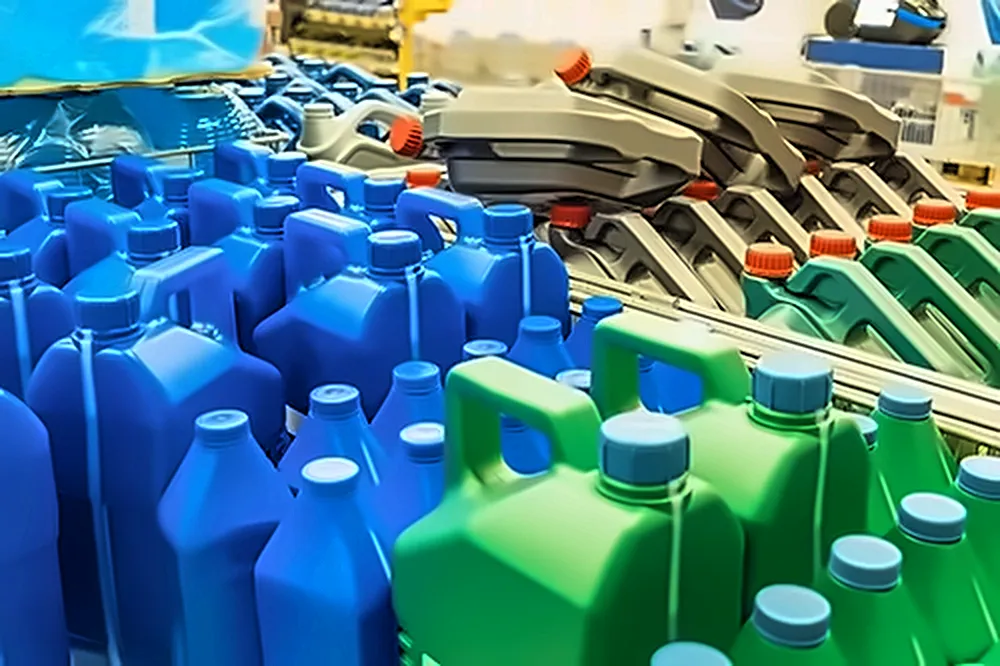
Biaxially oriented PET produced through ISBM offers optical clarity for product visibility, tensile strength 3–4× higher than unoriented equivalents (directly addressing the creep concern), and lower oxygen permeability than HDPE at equivalent wall thickness. For coolant bottles where the bright green, orange, or pink colour of the product is the primary consumer product identification cue, a transparent PET bottle with the coolant colour clearly visible is a direct commercial advantage over an opaque HDPE container with a label-only colour identification.
Chemical Compatibility Matrix for Common Automotive Fluids
Not all automotive fluids are equally compatible with all plastics. The selection of ISBM material for a specific automotive fluid application must be based on verified compatibility data at the product’s specific concentration, temperature, and storage duration. The following summary covers the most common automotive fluid categories:
| Fluid Type | PET Compatibility | HDPE Compatibility | Special Notes |
|---|---|---|---|
| Engine Coolant (ethylene glycol) | ✓ Excellent | ✓ Good | PET preferred for colour visibility |
| Motor Oil (mineral/synthetic) | ✓ Good | ✓ Excellent | Stability test required at 60°C |
| Brake Fluid (DOT 3/4/5.1) | ⚠ Limited | ✓ Preferred | Glycol ethers require validation |
| Power Steering Fluid | ✓ Good | ✓ Good | ATF mineral oils — full compatibility |
| Windshield Washer Fluid | ✓ Excellent | ✓ Excellent | PET preferred for visual clarity |
Always conduct a 6-week accelerated compatibility study at 40–60°C before commercial production adoption of any fluid-material combination.
Dimensional Requirements and Neck Finish Precision in Automotive Bottle Production
Automotive fluid bottles must satisfy closure and dispensing requirements that are more demanding than standard consumer packaging. Motor oil bottles with dosing spouts, coolant containers with wide-neck fill funnels, and brake fluid reservoirs with sealed tamper-evident closures all impose precise neck finish dimensional requirements. A neck finish that is 0.3mm out-of-round produces a closure that either cannot be tightened fully (creating leak risk) or cannot be removed by the end consumer without damaging the container. Neither outcome is acceptable in an aftermarket fluid packaging context where product integrity during storage and ease of use at the vehicle are the two critical functional requirements.
Injection-Formed Neck Finish: The ISBM Precision Advantage
The defining technical advantage of one-step injection stretch blow molding in automotive bottle production is the injection-formed neck finish. The neck is shaped by precision injection tooling to tolerances of ±0.05–0.10mm on thread major diameter, ±0.08mm on ovality, and ±0.10mm on finish height — achievable because injection moulding inherently produces tighter dimensional control than any stretch or fire-forming process applied to the same geometry. For automotive closure systems — particularly the HDPE quarter-turn dosing spouts used on motor oil bottles, and the tamper-evident snap-seal closures on brake fluid containers — this precision is the difference between a closure system that works as designed across every bottle in a production run and one that requires production line adjustment to handle dimensional outliers.
Common Neck Finish Specifications for Automotive Fluid Packaging
38mm Snap-Seal
Standard for 1L motor oil and transmission fluid containers. Accommodates integrated tamper-evident band with ±0.10mm finish diameter tolerance requirement.
45mm Wide Neck
Used for coolant and washer fluid containers requiring wide-mouth pour capability. Funnel-adapter compatibility demands ovality ≤ ±0.12mm across the full neck circumference.
28mm Precision Pour
Common for brake fluid and hydraulic oil. Thread engagement for sealed system closures requires ±0.05mm on thread minor diameter for reliable hydraulic seal performance.
Custom Spout Neck
Proprietary neck profiles for integrated dosing spout systems. ISBM injection-formed geometry reproduces custom profiles with the same tolerance as standard finishes.
Wall Thickness Engineering for Impact Resistance and Stackability
Automotive fluid bottles in the 1L–5L format range that dominate the retail aftermarket sector face two structural requirements that are sometimes in tension with each other: the bottle must be robust enough to survive palletised warehouse storage at 4–6 high stack with no base distortion or seam failure, and it must be light enough that the filled product-plus-container weight does not create handling difficulties for the end consumer. This tension is resolved through wall thickness optimisation — distributing material precisely where the structural model demands it, and removing it from zones that do not contribute to the relevant failure modes.
Biaxial Orientation and Wall Efficiency
PET processed through injection stretch blow molding achieves biaxial orientation — the polymer chains are aligned in both the axial and hoop directions simultaneously by the coordinated action of the stretch rod and blow pressure. This orientation increases tensile strength and modulus by 3–4× compared to unoriented PET, and by approximately 2× compared to HDPE at equivalent wall thickness. In practical terms, a 1L motor oil bottle in biaxially oriented PET at 0.35mm average body wall thickness can achieve the same top-load performance as a 0.55mm-wall HDPE bottle — meaning the ISBM PET bottle uses 35–40% less material per unit at equivalent performance. Over a production run of 10 million bottles per year, this material saving represents a directly quantifiable cost reduction that contributes to the commercial case for ISBM investment.
Base Design for Stacking Performance
The base geometry of an automotive fluid bottle governs its stacking performance more than any other design element. A flat-base design with a defined base push-up (the shallow recessed dome in the bottle centre) distributes the compressive load from the container above around the base perimeter ring, which is the structurally strongest zone because it has the highest material thickness and the highest biaxial orientation from the blow process. ISBM’s preform design allows the base push-up geometry to be precisely engineered — the wall thickness in the base perimeter ring zone and the push-up depth can both be specified in the preform tooling and are reproduced to ±0.2mm dimensional accuracy on every bottle. This base design precision is the foundation of the top-load performance that automotive fluid bottles require for palletised distribution.
The ISBM Production Process for Automotive Fluid Bottles: Step by Step
The one-step ISBM production sequence for automotive fluid containers integrates all forming stages in a single continuous cycle, eliminating the reheating and intermediate storage steps that two-step processes require. Each stage contributes to the dimensional and material performance of the finished container.
Resin Drying & Injection
PET resin is dried to ≤ 30 ppm moisture to prevent hydrolytic degradation during injection. The dried resin is injected into precision-machined neck and preform cavities at 270–290°C, forming the preform and neck finish simultaneously. The neck finish dimensions are set entirely at this stage by the injection tooling geometry.
Conditioning
The injected preform transfers to the conditioning station where infrared lamps bring it to the stretch-blowing temperature window (95–115°C for PET) with ±2°C circumferential uniformity. Precise temperature conditioning controls the biaxial orientation achieved in the blow stage and directly determines the final bottle’s wall thickness distribution and mechanical properties.
تمدد ونفخ
A precision servo-driven stretch rod extends axially to the base of the blow mould cavity while high-pressure air (25–40 bar) simultaneously expands the preform radially. The combination of axial stretch (stretch rod) and radial stretch (blow pressure) creates the biaxial orientation responsible for the container’s mechanical strength. Blow pressure profile, stretch rod speed, and timing are the key parameters governing wall thickness distribution.
التبريد والطرد
The blown bottle is held in the cooled mould cavity at 6–10°C coolant temperature for sufficient time to freeze the biaxially oriented structure before ejection. Premature ejection before the bottle wall temperature drops below the glass transition temperature causes dimensional distortion — the cooling time specification is validated during process qualification and held constant throughout production to ensure consistent geometry on every bottle.
Regulatory Compliance for Automotive Fluid Packaging in Australia
Automotive fluid packaging in the Australian market operates within a regulatory framework covering product safety, container compatibility, labelling, and chemical hazard classification. Meeting these requirements from the packaging design stage rather than retrofitting them during production is significantly more efficient — and ISBM’s process precision supports regulatory compliance in ways that are worth understanding in detail.
Australian Dangerous Goods Requirements
Motor oil, coolant concentrate, brake fluid, and many automotive chemical products are classified as dangerous goods under the Australian Dangerous Goods Code. Packaging for Class 3 (flammable liquids), Class 8 (corrosives), and non-hazardous automotive fluids must meet the relevant UN performance testing requirements for the packing group assigned to the specific product. UN performance testing for plastic containers includes a drop test (1.2m), a stacking test, a hydrostatic pressure test, and a permeation test — all conducted on containers filled with representative product at the specified test temperature. PET ISBM containers have been qualified to UN performance testing requirements across a wide range of automotive fluid applications. The key performance parameters — drop impact resistance, top-load strength, and thread engagement retention — are all directly traceable to the ISBM process parameters (wall thickness, orientation level, and neck finish dimensions) that the producer controls and validates during production qualification.
Tamper-Evidence Requirements
For automotive fluids marketed through retail channels — supermarkets, auto parts retailers, and service stations — tamper-evident closures are a standard commercial and regulatory requirement. The closure system’s tamper-evidence function depends on the neck finish dimensions being within specification: a finish that is slightly undersized allows the tamper-evident band to ride up and disengage without evidence of opening; a finish that is slightly oversized causes the band to fail at assembly, creating production line waste. ISBM’s injection-formed neck finish tolerance (±0.10mm on finish diameter) provides the dimensional consistency that tamper-evident closure systems require to function reliably across 100% of production output without individual bottle inspection or sorting.
Production Economics: ISBM vs. Alternative Approaches for Automotive Fluid Bottles
The economic case for using an آلة حقن القوالب بالنفخ والتمديد for automotive fluid bottle production rests on three quantifiable advantages: material efficiency through lightweighting, production speed from multi-cavity configurations, and supply chain simplification through local production. Each of these advantages has a different magnitude depending on the specific format, volume, and current supply chain structure of the operation evaluating ISBM.
Versus HDPE EBM at equivalent structural performance for 1L motor oil bottle format
Typical output from a 4-cavity ISBM system on 1L automotive fluid formats
Typical combined saving vs imported HDPE bottles when all supply chain cost factors are included
The material saving figure is the most immediately visible benefit because it feeds directly into the per-unit variable cost. A 1L automotive oil bottle in biaxially oriented PET at 28g preform weight delivers equivalent top-load and drop performance to a 42g HDPE EBM equivalent — a 14g per-bottle material saving that, at Australian PET resin pricing and a production volume of 10 million bottles per year, represents a very significant annual raw material cost reduction. When this saving is combined with the energy efficiency advantage of fully servo-electric ISBM machines (20–35% lower electricity consumption than hydraulic equivalents), the economic case for ISBM in automotive fluid bottle production is well-established for operations at the appropriate volume threshold.
Sustainability in Automotive Fluid Packaging: ISBM and the Circular Economy
The environmental footprint of automotive packaging has become a commercial concern as major automotive lubricant brands — including global majors operating in the Australian market — face retailer sustainability requirements and consumer scrutiny of their packaging practices. PET produced through ISBM has several sustainability credentials that HDPE EBM cannot easily match, and that the automotive fluid packaging sector is beginning to deploy commercially.
PET automotive fluid bottles are recyclable through Australian kerbside collection infrastructure and are eligible for Container Deposit Scheme participation in states where automotive fluid containers meet the size and type criteria. For lubricant brands with sustainability commitments, the ability to substantiate an on-pack claim of “recyclable through kerbside” or “contains X% recycled content” requires the packaging to be produced from a certified rPET blend — an achievable specification for ISBM operations processing 20–30% food-grade or industrial-grade certified rPET with the adaptive injection parameters that rPET IV variability requires.
Lightweighting through ISBM process optimisation contributes to reducing the embodied carbon of automotive packaging beyond what any other single production change can achieve at equivalent scale. A systematic lightweighting programme targeting all bottle formats in an automotive packaging range can reduce material use by 10–20% without structural performance compromise — a documentable Scope 3 emission reduction that automotive lubricant brands can report against their sustainability commitments.
Customisation Capabilities: Brand Differentiation in Automotive Fluid Packaging
Automotive lubricant brands operate in a competitive retail environment where shelf presence — particularly in the motor oil aisle of major auto parts retailers — is a direct driver of purchase decision. ISBM provides the tooling-enabled customisation capabilities that allow automotive packaging to differentiate on form, colour, and surface treatment within the same production platform used for standard commodity formats.
Embossed brand marks and product tier indicators (machined directly into the blow mould cavity) reproduce on every bottle at zero incremental per-unit cost — providing a permanent brand identity element that cannot be removed and that communicates brand investment to the retail buyer and the end consumer. Proprietary bottle silhouettes, engineered through custom blow mould design, create a recognisable bottle form that distinguishes the brand’s product on shelf and, once the form is registered as a three-dimensional trade mark, prevents competitor bottles from replicating it.
Colour masterbatch processing in ISBM production allows automotive packaging to use the product’s characteristic colour (black for motor oil, bright green for coolant, red for ATF) as a direct bottle tint rather than relying entirely on label colour to communicate product identity. A translucent dark-tinted PET motor oil bottle communicates “motor oil” at retail distance without the label being read — a visual shortcut that supports faster shelf navigation in the auto parts retail context.
Ever-Power’s Technical Support for Automotive ISBM Production in Australia
Australia Ever-Power Injection Stretch Blow Moulding Machine Co., Ltd, based in Condell Park NSW 2200, provides automotive packaging converters with a complete support package extending from pre-investment feasibility through machine supply, tooling development, commissioning, operator training, and ongoing process support. The local presence in NSW means same-day or next-day on-site engineering response for any production issue — a practical advantage that international machine suppliers based overseas cannot provide.
For automotive packaging converters evaluating whether to invest in in-house ISBM production versus continuing with offshore-supplied bottles, Ever-Power’s pre-investment analysis produces a site-specific total cost of ownership model covering all cost components — raw material, energy, labour, tooling amortisation, scrap, and supply chain overhead — to provide an investment decision grounded in accurate data rather than general industry averages.
Contact the team at [email protected] or visit the contact page to arrange a no-cost technical consultation for your automotive fluid bottle production requirements.
Recommended Machine
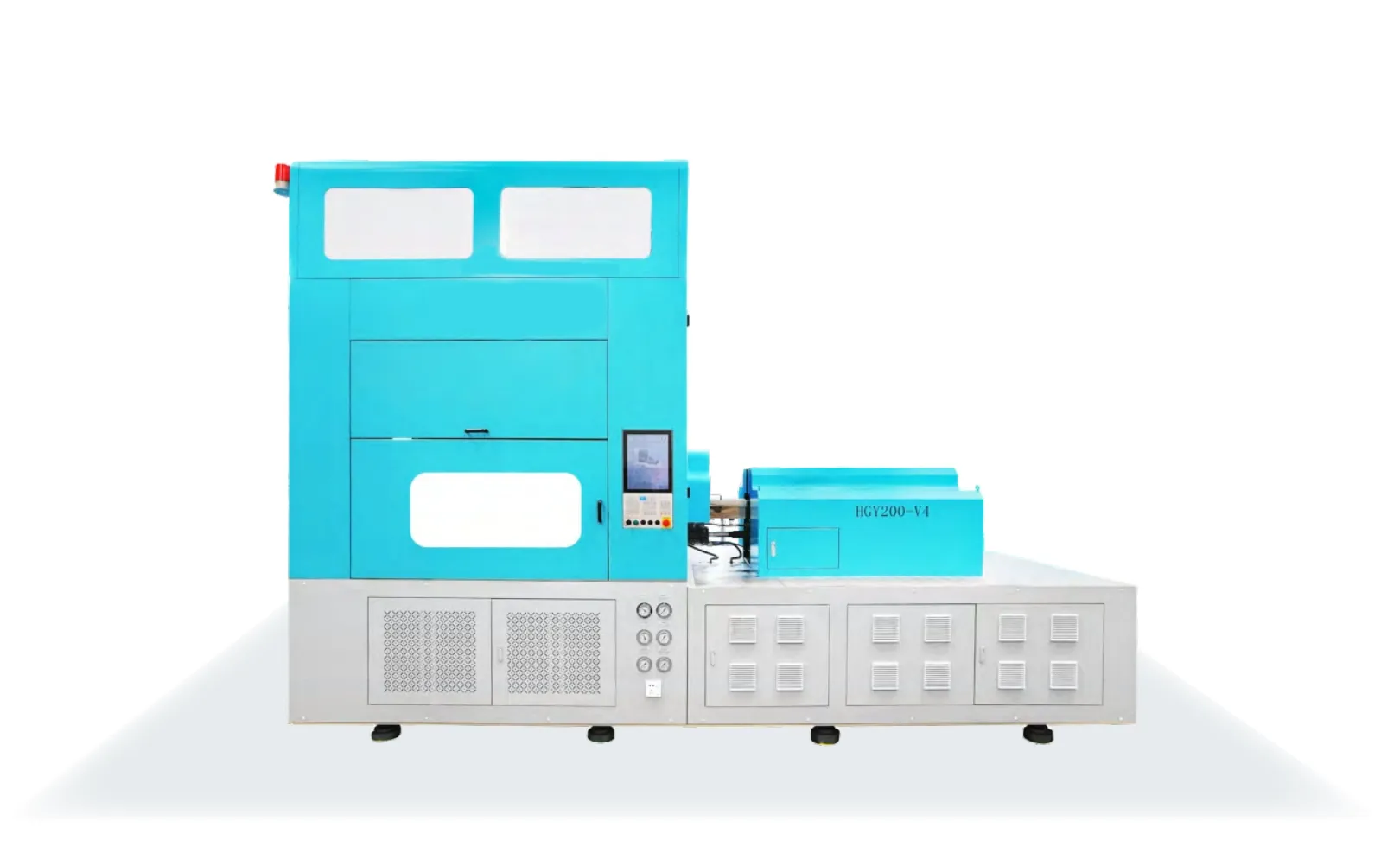
HGYS200-V4 — Four-Station One-Step ISBM Machine
For automotive fluid bottle production in the 500ml–2L format range at commercial volumes of 5–20 million units per year, the HGYS200-V4 four-station one-step ISBM machine delivers the production rate, neck finish precision, and process parameter control that automotive packaging specifications require. The four-station rotary architecture provides 3,500–6,500 BPH on standard 1L automotive formats with full servo-motion option for improved energy efficiency and process repeatability. The machine’s configurable neck insert system accommodates the full range of automotive closure neck finishes — snap-seal, wide-neck pour, and custom spout profiles — from a single machine platform. PET and rPET blends are both processable with the standard injection system.