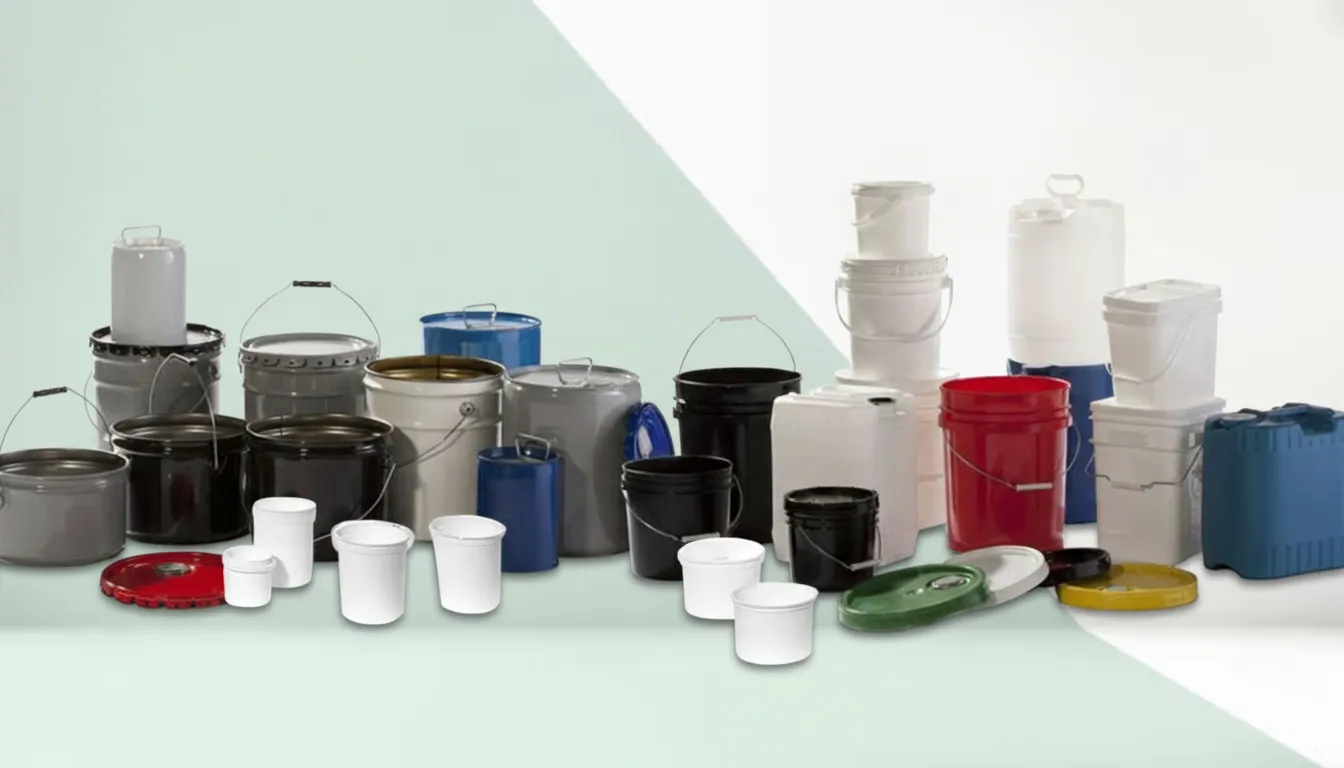

Brake fluid is the single most packaging-sensitive fluid in the automotive chemical category — not because of the consequences of a bottle dropping on a workshop floor, but because of what happens when the fluid inside is compromised before it ever reaches the vehicle. Glycol-ether-based brake fluids (DOT 3, DOT 4, DOT 5.1) are hygroscopic by design: they absorb atmospheric moisture to prevent free water from forming ice crystals in brake lines at low temperatures. But this same hygroscopic character means that moisture permeating through a bottle wall, migrating past a poorly sealed cap, or absorbed during a partially dispensed bottle’s storage life directly and measurably degrades the fluid’s dry boiling point — the safety-critical parameter that governs brake fade resistance under heavy braking. A DOT 4 fluid that absorbs 3% moisture by weight sees its equilibrium reflux boiling point drop from 230°C to approximately 155°C — well below the threshold at which vapour lock in brake calipers can cause brake pedal fade. Packaging that prevents this moisture ingress is not an engineering nicety in this category; it is a vehicle safety component.
Brake Fluid Chemistry and Its Packaging Imperatives
DOT Specifications and Moisture Sensitivity
Australian brake fluid specifications are aligned with US Federal Motor Vehicle Safety Standard FMVSS 116, which defines the DOT performance grades used in the market. DOT 3 (minimum dry boiling point 205°C) is the standard for older and lighter vehicles; DOT 4 (minimum 230°C) is the current standard for most modern passenger vehicles and light commercial; DOT 5.1 (minimum 260°C) serves high-performance applications including track vehicles and premium European sports cars. Each higher DOT grade demands a more rigorously moisture-protected package because the higher-performance polyglycol-ether chemistry that achieves the elevated boiling point is also more aggressively hygroscopic — absorbing moisture more rapidly than lower-grade formulations when packaging moisture barriers are inadequate.
The Contamination Risk Chain
The moisture contamination risk chain for brake fluid begins at the bottle production stage and continues through filling, sealing, warehousing, retail display and consumer storage — potentially spanning 24–36 months before the fluid is introduced to a vehicle. At each stage, moisture can enter through three pathways: vapour diffusion through the bottle wall (a function of the polymer’s moisture vapour transmission rate), leakage past the cap-thread interface (a function of neck finish dimensional accuracy and cap sealing force), and direct ingress when the bottle is opened and stored partially used (controlled by the reclosure design). The packaging specification must manage all three pathways simultaneously — a multi-variable engineering challenge that injection stretch blow molding addresses through superior moisture barrier and precision neck finish geometry that extrusion blow moulding cannot match at equivalent bottle weight.
Why ISBM Provides Decisive Moisture Barrier Performance
MVTR Reduction Through Biaxial Orientation
The moisture vapour transmission rate (MVTR) of PET is inherently lower than HDPE at equivalent wall gauge — approximately 5–10× lower in non-oriented material — and the biaxial orientation produced during injection stretch blow molding reduces PET’s MVTR by a further 30–50% compared to non-oriented PET of the same wall thickness. For brake fluid packaging, this double barrier advantage — material selection plus orientation — means that a standard ISBM PET brake fluid bottle allows approximately 10–15× less moisture vapour ingress per unit wall area per unit time than a standard extrusion blow-moulded HDPE bottle. Over a 24-month retail shelf life, this difference accumulates to a meaningful preservation of the dry boiling point that directly determines whether the fluid meets its DOT specification at the point of use rather than just at the point of fill.
Neck Finish Precision and Cap Vapour Seal
For the bottle-cap interface, ISBM’s injection-moulded neck finish achieves ±0.08–0.12mm dimensional tolerance on thread outer diameter and sealing surface geometry — the precision required for the foil induction seal applied to brake fluid containers to adhere uniformly across the neck sealing surface without the void zones that non-uniform sealing surfaces create. The induction foil seal on a brake fluid bottle serves a dual purpose: it provides tamper evidence that protects against product adulteration, and it creates a hermetic moisture barrier that supplements the cap thread engagement. A void in the foil seal as small as 1mm² can allow sufficient moisture ingress over 18 months to measurably degrade a DOT 5.1 fluid’s boiling point below specification. ISBM neck finish consistency eliminates this risk by ensuring the foil seal adhesive contacts a geometrically uniform surface at every production unit.
Bottle Volume Formats and Design Requirements for Brake Fluid
Consumer Retail Formats: 250ml and 500ml
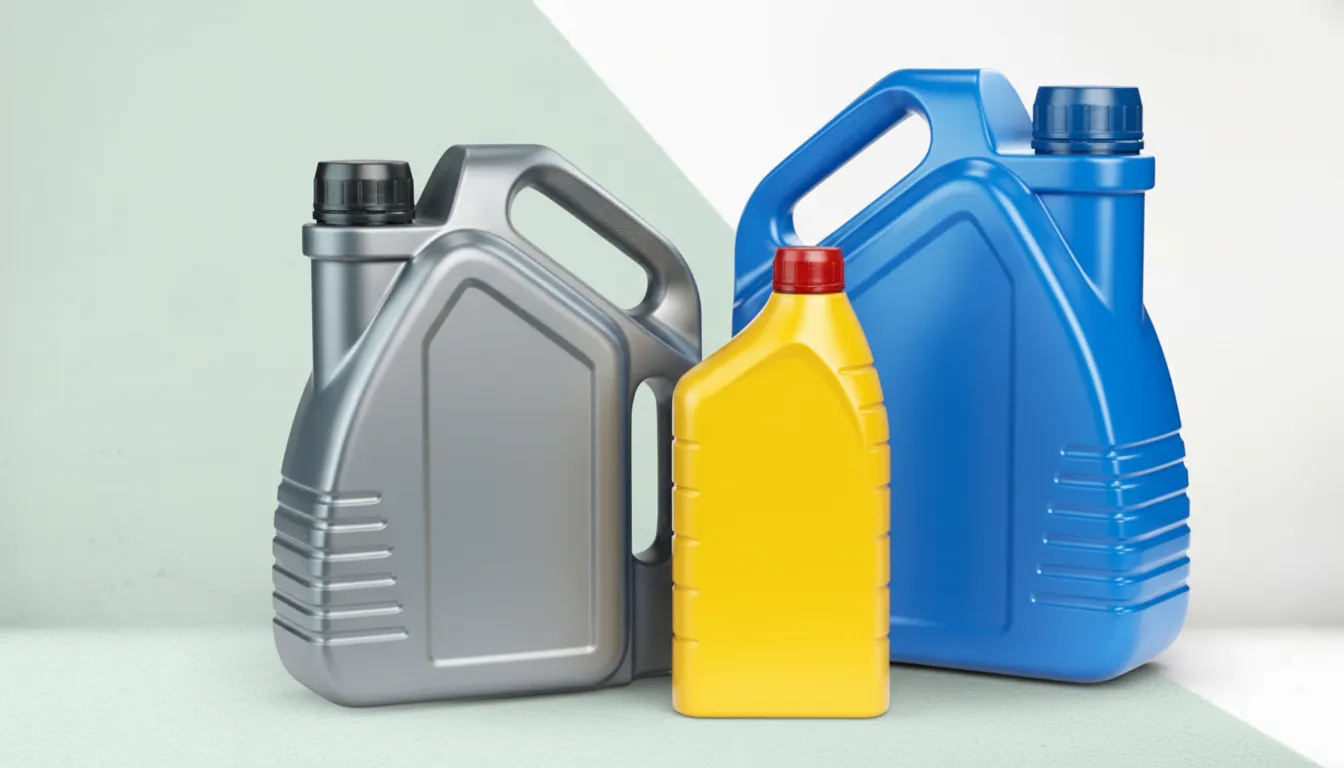
The 250ml and 500ml formats dominate retail brake fluid sales in Australia through the automotive aftermarket channel. These volumes are sized for a single-vehicle bleeding operation (typically 200–350ml consumed per full system bleed) with minimal surplus, which reduces the partially-used storage period that represents the highest moisture ingress risk. The 250ml retail bottle in clear or amber ISBM PET presents the fluid’s distinctive amber/yellow colour through the bottle wall — serving both product identification and visual quality check functions for professional technicians. Neck finishes in the 24/410 and 28/400 formats are standard, accommodating both drip-nozzle dispensing nozzles and fluid transfer pumps used in brake bleeding operations.
Workshop Bulk Formats: 1L to 5L
Workshop and fleet maintenance operations use 1-litre and occasionally 5-litre brake fluid containers for high-volume applications such as fleet vehicle servicing, brake system flushing on older commercial vehicles, and automotive training facilities. These larger formats require more robust moisture management design because the bottle-open time during workshop dispensing operations is longer, and partially emptied bottles may be reclosed and stored for subsequent service events. The packaging engineer’s solution for large-format brake fluid bottles is a combination of narrow-mouth neck (24–28mm) that minimises open-air exposure during dispensing, a high-quality induction foil primary seal, and a child-resistant reclosure cap that provides both tamper evidence and adequate thread engagement to maintain vapour-tight reclosure. Custom automotive bottles in this format are typically designed with a pour-control shoulder taper and a recessed drip lip to minimise cap thread contamination from dispensing spills — a workshop usability feature that reduces the risk of fluid residue compromising the reclosure seal.
Amber vs Clear PET for Brake Fluid Packaging
The choice between clear and amber PET for brake fluid bottles involves two competing considerations: product identification and UV protection. Clear bottles allow the professional technician to see the fluid’s characteristic amber-yellow colour directly through the container — providing immediate visual confirmation of product identity and a preliminary check for visual contamination, cloudiness or colour change that might indicate moisture absorption or product degradation. Amber bottles provide UV attenuation that protects photosensitive additive components (including certain metal deactivators and antioxidants in modern borate-ester DOT 4 formulations) from degradation under retail fluorescent lighting or sunlight during transit and outdoor display.
The practical resolution for Australian market brake fluid is typically a clear bottle for the dominant 250ml–500ml retail formats — where UV exposure during the retail phase is limited and product colour visibility is commercially valuable — and an amber or UV-inhibited clear bottle for industrial bulk formats where longer storage periods make photostability more relevant. ISBM accommodates both options through masterbatch pigmentation or UV-absorber additive incorporation at the injection stage, without any tooling change or production interruption. UV-absorber masterbatch in a clear PET brake fluid bottle provides UV protection without colour change — appearing visually identical to a standard clear bottle while absorbing the 290–380nm wavelengths most damaging to susceptible additive chemistries.
ISBM Production Workflow for Brake Fluid Bottles
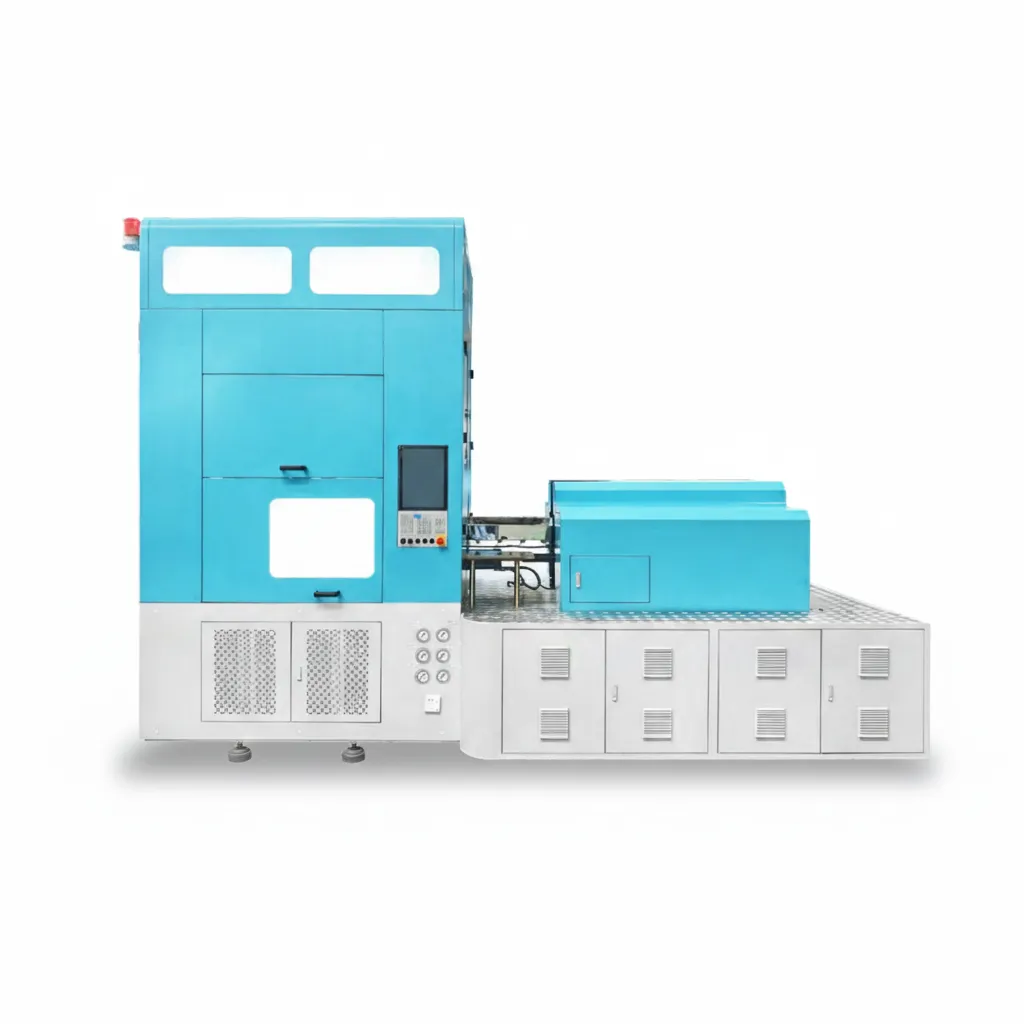
The production of brake fluid bottles on ISBM equipment demands tighter process discipline than most automotive chemical packaging because the moisture barrier and seal integrity requirements are more stringent. Each stage of the four-station cycle must be executed within tighter parameter windows to deliver the bottle performance that safety-critical fluid packaging requires.
① Precision Resin Drying
For brake fluid bottles where moisture barrier is the primary performance attribute, PET drying below 40 ppm (tighter than standard) is specified, with 165°C hopper dryer temperature and 5–6 hours residence time. Dew point monitoring at −45°C confirms adequate desiccant performance. Any moisture above 40 ppm in the PET melt causes hydrolytic IV reduction that measurably reduces the post-blow density of molecular orientation — directly reducing the MVTR improvement that biaxial orientation provides and compromising the barrier performance that makes ISBM PET superior to alternative packaging materials for this application.
② Preform Injection with Seal Surface Control
The 24/410 or 28/400 neck finish for brake fluid bottles is formed at injection-moulding precision. The induction seal surface — the flat annular ring inside the neck bore that receives the foil seal — must be held within ±0.05mm flatness deviation across its full circumference to ensure void-free foil adhesion. This precision is achievable only through injection moulding at the ISBM preform stage; blow-moulded neck formations produce sealing surface irregularities that create foil seal void risk at production-rate filling line speeds. Barrel temperature is held at 272–284°C to minimise IV degradation and maintain the molecular weight that maximises barrier performance in the blown bottle.
③ Controlled Thermal Conditioning
For brake fluid bottles where body barrier performance is the priority, conditioning zone temperatures are set toward the upper end of the range (110–116°C) to maximise the biaxial orientation achieved during stretch-blow — directly maximising MVTR reduction. For small-format 250ml bottles, the conditioning gradient is relatively uniform axially because the bottle’s near-cylindrical geometry requires consistent material flow without the differential stretch of complex shaped containers. Zone temperature uniformity within ±1°C between adjacent zones maintains the molecular orientation density that delivers the moisture barrier performance these safety-critical containers require.
④ High-Orientation Stretch-Blow
Stretch rod speed at 1.0–1.2 m/s — toward the upper end of the servo range — maximises axial PET chain alignment before pre-blow air at 6–8 bar initiates radial expansion. High-pressure blow at 32–40 bar drives full mould contact, producing the high gloss, minimal surface defect body that brake fluid’s amber colour should read through without visual interference. Extended blow dwell at 8–14°C mould cooling (3.5–5 seconds) ensures the maximum crystallinity that delivers both moisture barrier and dimensional stability under the thermal cycling conditions of automotive workshop storage.
⑤ Sealing Surface and Barrier Verification
Brake fluid bottles undergo additional quality verification steps beyond standard automotive packaging: neck finish sealing surface flatness is gauged by contact profilometry on statistical samples, and oxygen/moisture transmission rate testing on a representative sample from each tooling qualification confirms barrier performance meets the specified MVTR limit. Batch traceability records linking production parameters, resin lot, colour/UV additive lot and inspection results are maintained to support DOT product dossier documentation requirements and product recall capability for safety-critical automotive fluid packaging.
Critical Machine Parameters for Brake Fluid Bottle Production
| Parameter | Brake Fluid Target | Why It Matters for Safety Fluids |
|---|---|---|
| PET moisture at injection | <40 ppm (tighter than standard) | Maximises IV retention → maximises barrier performance |
| Injection barrel temp | 272–284°C | IV preservation; neck sealing surface definition |
| Conditioning temp precision | ±1°C zone-to-zone | Maximises orientation density → MVTR reduction |
| Stretch rod speed | 1.0–1.2 m/s | Axial chain alignment; primary barrier determinant |
| Blow dwell time | 3.5–5.0 seconds | Maximum crystallinity; dimensional stability |
| Neck sealing surface flatness | ±0.05mm maximum deviation | Void-free induction foil seal — moisture barrier continuity |
The parameter that most distinguishes brake fluid bottle production from other automotive fluid bottles is the tighter PET moisture specification at injection and the higher minimum stretch rod speed. Both are directed at maximising the molecular orientation density achieved during the stretch-blow stage — which is the primary engineering lever for minimising MVTR through the bottle wall without increasing wall gauge or material weight. At rod speeds below 0.9 m/s, axial orientation is incomplete before radial blow expansion begins, yielding lower biaxial orientation density and measurably higher MVTR values in the finished bottle. For brake fluid DOT specification compliance over a 24–36 month shelf life, the investment in servo-driven stretch rod speed control that ISBM machines provide is directly translatable into product performance margin above the DOT boiling point specification at point of use.
Regulatory Compliance for Brake Fluid Packaging in Australia
Automotive brake fluid sold in Australia with DOT performance designations must comply with the requirements of US FMVSS 116 as the de facto standard referenced by Australian vehicle manufacturers’ service specifications. While FMVSS 116 is a US regulation, Australian-market brake fluids are effectively required to meet its dry and wet boiling point requirements because the vehicles they service specify compliance as a maintenance requirement. The packaging specification is not explicitly part of FMVSS 116 compliance, but it directly governs whether the product’s boiling point remains above the specified minimums at the point of use — creating an implied packaging performance obligation that responsible manufacturers address through documented moisture barrier specifications and shelf-life testing protocols.
GHS hazard classification under Australia’s HCIS framework places ethylene glycol and polyglycol-ether based brake fluids in the Acute Toxicity Category 4 (Oral) and the Skin Corrosion/Irritation Category 2 designations. This requires the label to carry the exclamation mark hazard pictogram, the Warning signal word, H302 (harmful if swallowed) and H315/H319 hazard statements, plus relevant precautionary text. For child-resistance requirements, brake fluid containers in Australia are subject to the Poison (Standard for Packaging and Labelling) standards under the Poisons Standard (SUSMP), which specifies child-resistant closures for certain hazardous liquid categories. The cap specification for retail brake fluid bottles must confirm child-resistance compliance in the context of the specific bottle neck geometry and cap design, tested to AS 8124 or equivalent standards for the Australian market.
Testing Protocols and Quality Assurance for DOT-Specification Brake Fluid Bottles
Quality assurance for brake fluid packaging goes beyond standard automotive chemical bottle testing because the safety implications of moisture-degraded product reaching a vehicle’s brake system are significant. The core testing programme for ISBM PET brake fluid bottles encompasses four areas. First, moisture vapour transmission rate testing: gravimetric MVTR measurement on production samples using ASTM E96 or ISO 15106 methods, with pass criteria aligned to the shelf-life moisture absorption budget calculated from the DOT fluid specification. Second, induction foil seal integrity testing: helium leak testing on sealed bottles to confirm seal coverage and identify void zones, supplemented by peel-force measurement to confirm adhesion uniformity across the sealing surface circumference.
Third, chemical compatibility verification: 90-day immersion testing at 50°C using the specific brake fluid formulation, assessing dimensional change, weight change, surface appearance and mechanical properties against pre-soak baseline values. DOT 5.1 fluids require particularly careful compatibility assessment because their high polyglycol-ether content and low water activity relative to lower-DOT formulations create a different chemical environment that must be validated against the specific PET bottle specification rather than assumed compatible from DOT 3 or DOT 4 test data. Fourth, shelf-life simulation testing: filled and sealed production bottles stored at 50°C for 6 months (equivalent to approximately 24 months at ambient temperature under Arrhenius acceleration assumptions) with boiling point measurement at intervals to confirm the DOT specification is maintained throughout the simulated shelf life with adequate margin above the minimum requirement.