
Every litre of lawn herbicide that leaves a warehouse shelf must arrive at the end user in precisely the condition it left the filling line — active ingredient concentration intact, closure secure, and container structurally sound after handling, transit, and potentially a full season sitting in a garden shed. Injection stretch blow molding produces PET bottles whose biaxially oriented walls deliver the chemical barrier, dimensional stability, and CRC-grade neck precision that herbicide packaging demands across the entire distribution chain — at commercial throughputs that make the economics competitive with legacy HDPE extrusion alternatives. This article examines how the PET bottle production workflow maps onto the real-world requirements of lawn and turf herbicide packaging, from formulation compatibility through to APVMA regulatory documentation.
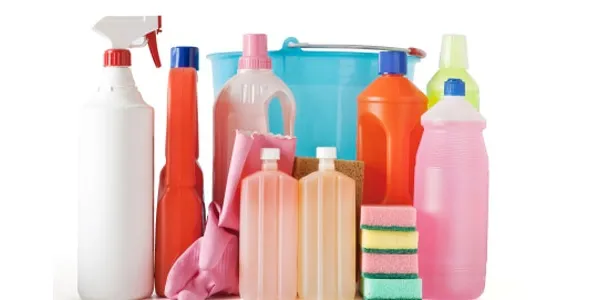
Herbicide Packaging: Where Regulatory Compliance Meets Supply-Chain Durability
The Australian Turf-Care Herbicide Market
Australia’s lawn and turf herbicide sector spans consumer retail — ready-to-use trigger sprays for home lawns — through to professional turf management concentrates used by local councils, sports facility operators, golf courses, and commercial landscaping contractors. The consumer end of the market is dominated by 500 mL to 1 L formats; the professional segment runs from 1 L up to 5 L and beyond. Both segments share an uncompromising requirement: the active ingredient concentration stated on the label must remain within tolerance across the product’s full shelf life, which APVMA label registrations typically specify at 24 to 36 months. Packaging that allows active ingredient permeation, stress-crack failure, or closure leakage does not just create a consumer complaint — it triggers an APVMA notifiable packaging incident and can result in product recall.
Format Demands Across the Consumer-Professional Spectrum
Consumer herbicide formats — trigger-spray RTU (ready-to-use) bottles at 500 mL to 1 L — prioritise ergonomic grip, single-handed operation, and the visual clarity that allows fill-level monitoring without label removal. Professional concentrate formats at 1 L to 5 L demand palletised stack rigidity, robust closure re-sealability across multiple-use seasons, and batch-traceable labelling surfaces that withstand outdoor UV exposure in shed storage. The one-step ISBM platform addresses the consumer segment in particular with a precision and aesthetic quality that HDPE extrusion simply cannot match — and does so at throughputs exceeding 4,000 bottles per hour on a single four-station machine, making the economics of ISBM PET bottle production genuinely competitive for any herbicide producer running annual volumes above 2 million units.
Regulatory Framework: APVMA, SUSMP, and ADG Code
Lawn herbicide packaging in Australia sits at the intersection of three regulatory frameworks. The APVMA (Australian Pesticides and Veterinary Medicines Authority) requires that primary packaging be specified and validated as part of the product’s label registration, including material compatibility data. The SUSMP (Standard for the Uniform Scheduling of Medicines and Poisons) mandates child-resistant closures for herbicide products whose active ingredient concentrations trigger Schedule 5 or Schedule 6 classification — covering many consumer-market glyphosate and phenoxy herbicide concentrates. Where herbicide formulations are classified as Class 6.1 or Class 8 Dangerous Goods under the ADG Code, UN-performance packaging certification is required for road transport. ISBM-produced PET bottles can be certified to UN Packing Group II and III standards, satisfying all three frameworks simultaneously — a compliance convergence that legacy HDPE packaging achieves only with considerably greater tooling and process complexity.
Formulation Chemistry and PET Barrier Performance
Glyphosate, Phenoxy Acids, and Aqueous Concentrates
The majority of Australian consumer lawn herbicides are based on glyphosate isopropylamine (IPA) salt solutions at 360–480 g/L, or phenoxy active ingredients — 2,4-D amine and MCPA amine salts — at 300–750 g/L in aqueous carrier systems. These are relatively benign from a polymer-compatibility standpoint: aqueous amine salt solutions at pH 3.5–6.0 present no significant stress-cracking or permeation risk to biaxially oriented PET across the full two-to-three-year shelf life at ambient Australian storage temperatures. The principal mechanism of active ingredient loss from ISBM PET containers for these formulations is straightforward aqueous permeation — which the biaxially oriented molecular structure reduces to below 0.1% of fill weight annually at commercial wall thicknesses. This level of permeation loss is undetectable within APVMA label claim tolerances and poses no risk of secondary packaging contamination.
Surfactant Adjuvants and Co-Solvent Carriers
Modern herbicide formulations typically incorporate non-ionic surfactant adjuvants — polyethoxylated tallow amines, alkylpolyglucoside, or organosilicone surfactants — to enhance foliar uptake and raindrop fastness. These surfactants at commercial adjuvant concentrations (0.5–5%) are fully compatible with ISBM PET and present no stress-cracking or surface attack risk. Where co-solvent systems are used to dissolve active ingredient salts — isopropanol up to 15%, N-methylpyrrolidone up to 10% in some specialist penetrant herbicide concentrates — pre-production compatibility testing at 40 °C for 28 days is the recommended verification step. For standard aqueous glyphosate and phenoxy formulations without significant solvent loading, formal compatibility testing is a regulatory documentation requirement rather than a technical uncertainty: the outcome is predictably favourable and the test data serves primarily to populate the APVMA dossier.
UV-Light Protection for Photosensitive Actives
Certain triazine herbicides — simazine, atrazine, and related compounds used in non-selective turf renovation applications — are susceptible to photolytic degradation when their packaging allows UV transmission through a transparent wall. ISBM accommodates two complementary UV-management strategies. The first is pigment masterbatch: amber at 0.3–0.6% loading or green at 0.4–0.8% provides broad-spectrum visible and UV attenuation while maintaining sufficient translucency for fill-level assessment. The second is UV-absorber additive masterbatch at 0.05–0.12% loading in clear or lightly tinted containers, providing targeted UV-A and UV-B blocking without affecting optical clarity. Both strategies are introduced at the injection stage with no tooling modification and no per-unit cost increment beyond the masterbatch input itself — a commercially attractive UV-management solution compared to the secondary coating or UV-barrier-layer co-extrusion approaches required in HDPE packaging.
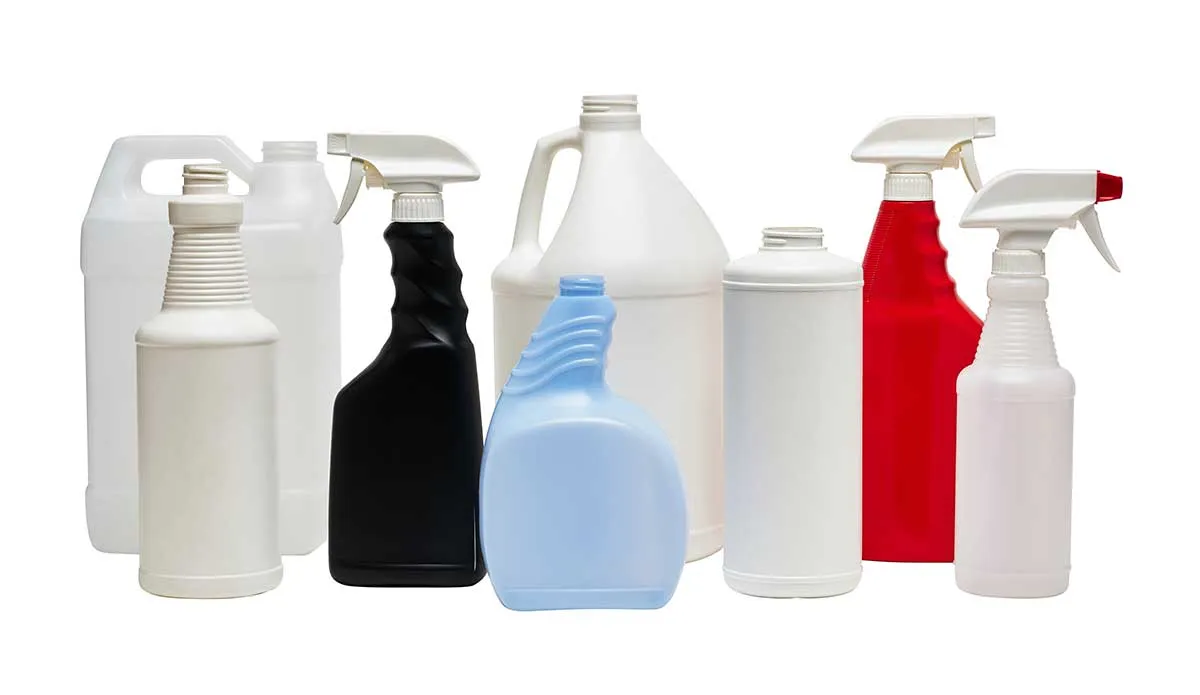
The One-Step ISBM Production Cycle for Herbicide Bottles
For a containment-critical product class like herbicide, the thermal consistency of one-step injection stretch blow molding is a genuine technical requirement. Because the preform never fully cools between injection and blowing, the biaxial crystalline structure that develops during stretch-blow is more uniform than in two-step reheat-blow systems — and a more uniform crystalline network means more consistent barrier performance across every bottle in the production population.
Resin Specification & Drying
Agricultural-grade PET at IV 0.80–0.84 dL/g is selected for enhanced molecular weight retention during processing — higher IV translates to better orientation density during blowing and superior barrier performance in the finished bottle. Drying targets below 50 ppm moisture at 165–170 °C for 5–6 hours; any moisture above this threshold causes hydrolytic chain scission that creates localised brittleness vulnerable to chemical stress cracking.
CRC Preform Injection
Molten PET at 270–288 °C fills preform cavities with CRC neck profiles injection-formed to AS/NZS 8809 dimensional standards. The neck finish is formed entirely at this stage — it will never be subjected to blow pressure — so CRC thread-lead accuracy of ±0.03 mm and outer-diameter roundness of ±0.05 mm are achievable without secondary machining. UV masterbatch or amber pigment is blended at the hopper and distributed uniformly through the preform wall.
Thermal Conditioning
The preform body is brought to 100–115 °C — the window where PET is most amenable to biaxial stretching without surface crystallisation — while the neck zone is chilled below 72 °C. Circumferential temperature uniformity across the preform body at this stage is the single greatest determinant of consistent wall distribution in the blown bottle, directly governing whether the thinnest wall zone falls within or outside the minimum design specification.
Servo Axial Stretch
Servo-driven stretch rods extend at programmed velocity profiles achieving axial ratios of 2.8–3.6×. Herbicide concentrate bottles — tall and narrow for stable shelf standing — benefit from higher axial ratios (3.2–3.6×) that concentrate biaxial orientation in the sidewall: the region carrying maximum tensile load from a full column of dense aqueous concentrate with specific gravity 1.10–1.25 g/mL.
High-Pressure Blow
Air at 30–40 bar inflates the oriented preform against mold walls chilled to 10–14 °C. Rapid chilling locks the biaxial crystalline structure before molecular relaxation can occur — securing both the dimensional precision of the body profile and the barrier architecture of the wall. Hoop stretch ratios of 2.8–3.4× deliver sidewall tensile strength of 130–160 MPa post-blow.
Ejection & APVMA-Grade QC
Bottles eject to vision inspection covering CRC neck geometry, wall thickness distribution, base integrity, and UV-masterbatch colour consistency. Batch data — cavity ID, production timestamp, resin lot, drying parameters — is logged to the quality management system for inclusion in the APVMA dossier. Scrap rates on stable herbicide ISBM lines run consistently below 0.8%.
Tooling Design for Herbicide Bottle Compliance
CRC Neck Geometry and AS/NZS 8809 Compliance
Child-resistant closure neck finishes are among the most dimensionally demanding geometries in the bottle manufacturing industry. AS/NZS 8809 specifies thread profiles with functional engagement dimensions that must fall within ±0.05 mm to achieve the push-and-turn or squeeze-and-turn release mechanism that both prevents child access and remains operable by adults. Because ISBM forms the neck entirely during injection — before any blow pressure is applied — it is the only blow molding process that routinely achieves this tolerance at production volume without machining. The practical consequence is that CRC engagement force testing on ISBM-produced herbicide bottles consistently returns pass rates above 99.5%, versus the 92–96% typical of EBM lines producing CRC necks with parison wall-thickness variation contributing dimensional scatter.
Dosing Interface and Pour Control
Consumer herbicide concentrates are almost universally sold with a graduated measuring cup that serves as both the dispensing closure and the mixing-ratio tool. The clip-fit outer diameter of this cup seats over the bottle neck finish with a clearance of ±0.30 mm — a tolerance that ISBM’s injection-formed neck delivers with production consistency that eliminates the loose or over-tight cup fitment that generates consumer complaints at scale. Pour-control geometry — a defined step at the shoulder-to-neck transition that modulates flow rate during inverted dosing — can be integrated directly into the mold design without per-unit cost impact. This feature reduces the over-pour incidents that drive up herbicide application rates, overspend per application, and occasionally trigger turf-burn complaints on sensitive grass varieties.
Shoulder and Base Structural Design
Herbicide bottles must withstand the top-load forces of palletised multi-layer stacking during warehouse and retail storage — typically 6–8 layers for consumer formats at 1.1–1.2 kg fill weight. The shoulder region carries the highest stress concentration during top-load, and ISBM tooling design must specify shoulder wall thickness above the minimum structural calculation. FEA-based wall distribution modelling, standard practice at experienced ISBM toolmakers, predicts shoulder wall thickness for any given preform design before steel is cut — eliminating the trial-and-error iterations that add 4–8 weeks to tooling development timelines in less-systematised shops. Base design for herbicide bottles incorporates a 2–4 mm peripheral standing ring engineered to prevent base dome reversal under the hydrostatic load of a full-weight fill — a failure mode that is cosmetically damaging and, in a retail context, triggers product returns.
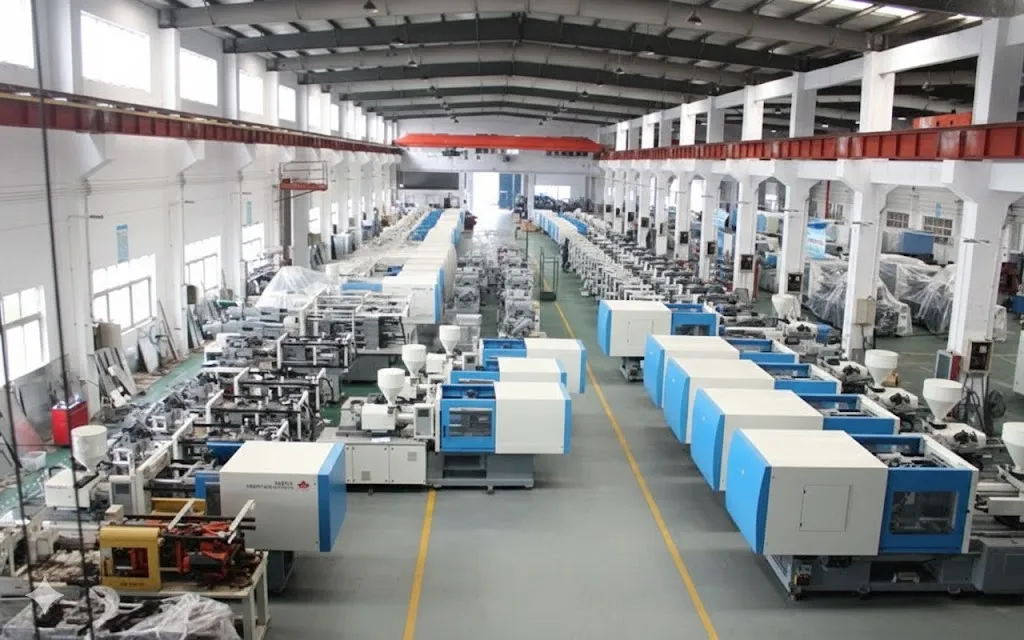
Production Performance Metrics
Benchmark figures for a six-station ISBM machine running a 1 L consumer herbicide concentrate bottle in amber PET with CRC 38/400 neck tooling.
Quality Assurance for APVMA-Registered Herbicide Packaging
🌡️ Accelerated Compatibility Study (40 °C / 28–42 Days)
Bottles filled with the target herbicide formulation are stored at 40 °C for a minimum of 28 days (42 days for APVMA-registration-grade data). Measurements recorded at 7-day intervals include fill-weight change (permeation indicator), dimensional stability at four body measurement points, neck-finish outer-diameter retention, and visual inspection for stress cracking or hazing. Data output constitutes the primary packaging compatibility evidence for the APVMA product dossier and supports the registered shelf-life claim.
🔒 CRC Force Measurement and Thread Gauging
AS/NZS 8809 Go/No-Go gauges verify CRC thread dimensions on every batch. Random sample groups of 30 bottles undergo child-resistance panel testing: engagement force measured at 15–45 N with adult release below 65 N. Post-three-cycle re-torque tests simulate seasonal multi-use concentrate containers. Any batch failing thread-gauge verification triggers immediate injection process investigation before further production proceeds.
📦 UN Drop Test and Stack-Load Certification
Where ADG Code classification applies, filled bottles undergo 1.2 m drop testing across six orientations, hydraulic pressure hold at 1.5× working pressure, and 24-hour stack-load assessment at the maximum pallet configuration weight. ISBM PET bottles at commercial wall thicknesses consistently achieve Packing Group III certification for Class 6.1 and Class 8 herbicide formulations, providing the UN certification documentation required for road transport compliance under the ADG Code.
📊 Wall Thickness SPC with Cavity-Level Traceability
Every 50th bottle is sampled for 12-point ultrasonic wall thickness mapping. SPC control charts with ±15% deviation triggers prompt process correction before off-specification bottles reach packaging. Every bottle’s production data — cavity number, timestamp, resin lot, IV measurement — is logged for recall traceability. This data chain supports APVMA’s post-market surveillance requirements and enables corrective action within minutes of any field containment report.

Sustainability and APCO Compliance in Herbicide Packaging
Lightweighting: Structural Efficiency of Oriented PET
The biaxial orientation of ISBM PET delivers a tensile strength of 130–170 MPa post-blow — significantly higher than the 25–35 MPa of unoriented HDPE extrusion blow products at equivalent density. This strength differential allows herbicide bottle walls to be thinned by 18–26% versus HDPE equivalents at the same top-load and drop-test performance standards. For a 1 L herbicide concentrate bottle that might weigh 38–42 g in HDPE-EBM, the ISBM PET equivalent runs at 28–32 g — a 10 g per-unit saving that translates to approximately 70–100 tonnes of polymer per 10 million bottles annually. Under APCO’s 2025 National Packaging Targets, this lightweighting outcome is a reportable metric and a compliance contribution that retail buyers and major agricultural cooperative purchasing groups increasingly require from supplier brands.
rPET Integration for Recycled Content Claims
Post-consumer recycled PET at 25–30% inclusion rates can be processed through ISBM machines without tooling modification for herbicide bottle formats where amber or green pigmentation is specified — the warm colour masks the minor colour variation inherent in rPET feedstocks and provides a visually consistent product. The APVMA does not restrict rPET use in agricultural chemical packaging provided the recycled material meets the safety and purity standards relevant to chemical contact — typically food-contact-equivalent purity for consumer-market herbicides. Brands incorporating verified rPET content gain a measurable recycled-content claim that supports both APCO reporting and the sustainability commitments increasingly required by major grocery and hardware retail chains as conditions of supplier approval.
PET Recyclability in Kerbside and Agricultural Return Streams
PET Type 1 is accepted in Australia’s kerbside collection stream at higher rates than HDPE (Type 2) for many councils, because the established beverage bottle PET recycling infrastructure provides a high-value end market that drives collection investment. For consumer-market herbicide bottles sold in retail hardware and garden-centre channels, the kerbside recyclability of PET provides a credible end-of-life story that APCO’s packaging reporting system can verify. For professional-channel concentrates, the ChemClear agricultural chemical container collection programme provides a sector-specific take-back mechanism. ISBM PET herbicide bottles — particularly those designed with label materials and adhesives compatible with the wash-float recycling process — satisfy both the APCO recyclability design standard and the ChemClear programme’s accepted container types.
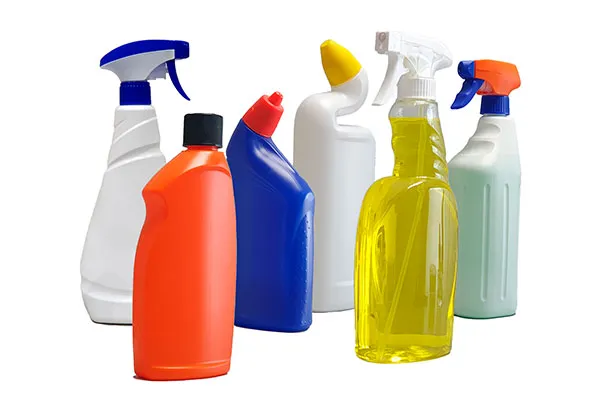
Recommended Equipment: HGYS280-V6 for High-Volume Herbicide Bottle Production
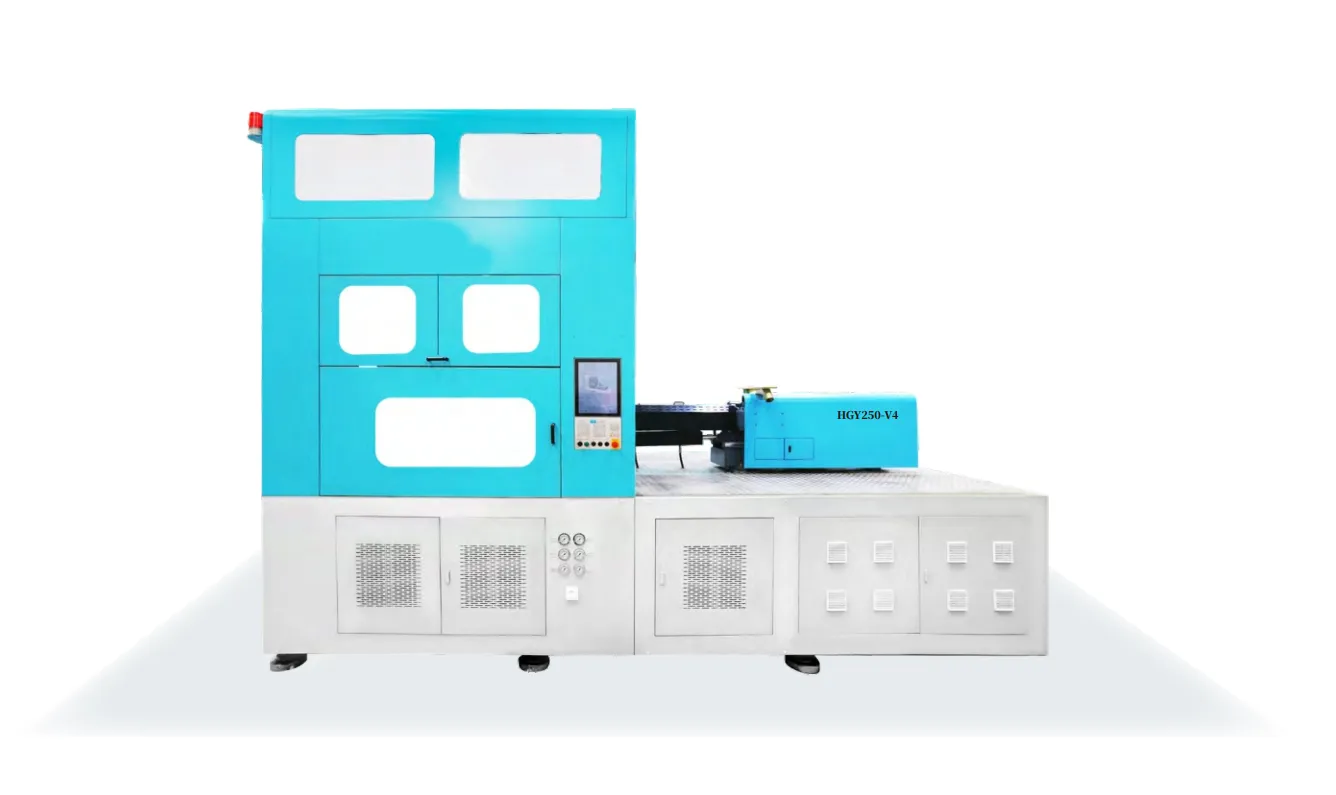
HGYS280-V6 Six-Station One-Step Injection Stretch Blow Molding Machine
For herbicide bottle producers targeting annual outputs above 40 million units, the HGYS280-V6 one-step injection stretch blow molding machine delivers the step-change in throughput that makes ISBM PET economically decisive against HDPE-EBM at volume. Its six-station indexed carousel runs all process stages simultaneously, achieving output rates above 6,000 bottles per hour on standard 1 L herbicide concentrate formats — while the servo-driven clamping and stretch systems maintain the CRC neck tolerances that APVMA-registered packaging demands. The machine’s higher clamp force suits the wider-body 2–3 L professional concentrate formats that require greater mold-parting resistance during blow.
- Output: 6,000+ bottles/hr (1 L herbicide format)
- Volume range: 200 mL – 3,000 mL
- Six-station carousel: maximum simultaneous throughput
- CRC neck finish: AS/NZS 8809 dimensional compliance
- Handles amber, green, and white-pigmented PET + rPET
- CE certified; Australian WHS electrical standards compliant