Food Condiment Packaging: Where Food Safety, Visual Appeal, and Consumer Convenience Intersect
Sauce, condiment, and food condiment packaging — tomato sauce, mustard, mayonnaise, soy sauce, hot sauce, salad dressing, honey, syrup, and a wide range of specialty food products — sits at the intersection of food safety regulation, consumer convenience engineering, and retail shelf competition. The container must protect the food product’s microbiological integrity across its shelf life, dispense consistently without mess, communicate brand and product identity on a competitive retail shelf, and satisfy increasingly demanding sustainability requirements from major retail buyers.
Der injection stretch blow molding machine addresses all four of these dimensions simultaneously — food-contact-grade PET with certified extractable profiles, precision dispensing neck finishes, optical clarity for product visibility, and the production economics and lightweighting capability needed to compete in value-driven food categories. For Australian food manufacturers, local ISBM production adds a fifth dimension: supply chain agility that offshore sourcing cannot provide in a market where seasonal demand swings, retailer promotional cycles, and new product launches require fast packaging response times.
Australia Ever-Power Injection Stretch Blow Moulding Machine Co., Ltd, based in Condell Park NSW 2200, serves Australian food manufacturers and co-packaging operations with ISBM machine technology, tooling development, and process support tailored to food packaging regulatory requirements and production standards.
Food Safety Compliance for PET Condiment Bottles: Australian Regulatory Requirements
Food packaging in Australia is regulated under Food Standards Australia New Zealand (FSANZ) Standard 1.4.1 (Contaminants and Natural Toxicants) and Standard 1.1.1 provisions relating to food contact materials. Packaging materials that contact food must not transfer substances to the food at levels that constitute a hazard to health, a contaminant, or an unacceptable organoleptic change. PET produced from food-contact-grade resin through ISBM meets these requirements when the production process is managed correctly — the key condition being “managed correctly,” which has specific technical implications for the ISBM process.
Acetaldehyde Migration: The Critical PET Food Contact Parameter
Acetaldehyde (AA) is a trace degradation product formed during PET melt processing, produced by the thermal decomposition of PET chains at elevated temperatures or under conditions of extended barrel residence time. AA migrates from PET container walls into food products in contact with the container, where it produces a detectable off-flavour at concentrations above approximately 20–40 µg/L in aqueous food products. In carbonated beverages, the AA limit is more stringent (typically below 10 µg/L) because the carbonation amplifies AA perception. For food condiment applications, AA migration is typically managed to below 20 µg/L through correct AA control in the ISBM process — a target achievable through: AA-scavenger additive incorporation in the PET resin, controlled barrel temperature profiles that minimise thermal degradation, short barrel residence time management (purging the barrel before extended stoppages), and screw tip speed control that limits shear-generated heat. ISBM production operations producing food condiment bottles should monitor AA levels in trial batches at commissioning and maintain the process parameters that achieve the validated AA result.
Overall Migration and Specific Migration Compliance
Beyond AA, food-contact-grade PET must meet overall migration limits (OM ≤ 10 mg/dm² in European standard, referenced by Australian food manufacturers targeting export markets) and specific migration limits for individual substances of concern, including primary aromatic amines, antioxidants, and polymerisation catalysts. PET produced from certified food-contact resin grades from reputable suppliers (Eastman, Indorama, DAK Americas, etc.) has established compliance data that supports FSANZ requirements without individual migration testing for standard condiment food-contact applications. For novel food products, specialty formulations, or export markets with different regulatory frameworks, migration testing on production bottles may be required — Ever-Power provides technical guidance on the testing approach and accredited laboratory options for Australian food manufacturers.
Dispensing Precision for Condiment and Sauce Products
Condiment dispensing is one of the most consumer-visible functional aspects of food packaging — the consumer’s experience of dispensing tomato sauce, honey, or soy sauce from a bottle directly influences their perception of the product and the brand. A sauce bottle that drools after dispensing, fails to cut off cleanly, or requires excessive force to squeeze consistently is perceived as a quality failure, even if the sauce formulation is identical to a competitor’s product in a better-functioning container. ISBM addresses condiment dispensing performance through two mechanisms: neck finish precision for closure compatibility, and wall flexibility engineering for squeeze dispensing.
Neck Finish Precision for Dispensing Closures
Condiment dispensing closures — flip-top spouts for honey and sauce, precision-dispensing nozzle caps for soy sauce and vinegar, disc-top closures for dressings, and sports cap dispensers for ketchup — all require the bottle neck finish to be within defined dimensional tolerances for the dispensing mechanism to function as designed. The most common failure modes in condiment dispensing closure systems are: incomplete engagement of the closure onto the neck thread (causing premature removal or difficulty opening for the consumer), inadequate sealing on the neck sealing surface (causing drool and dribbling after dispensing), and incorrect nozzle cut-off from a nozzle cap that does not seat correctly due to finish height variation. ISBM’s injection-formed neck eliminates each of these failure modes at their source — the neck dimensions are formed by tooling geometry and replicated with ±0.08–0.10mm consistency on every bottle.
Squeeze-Dispensing Characteristics for Viscous Sauces
Viscous condiment products dispensed by squeezing the bottle body — tomato sauce, mustard, mayonnaise, BBQ sauce — require a specific wall flexibility profile. The bottle body must be flexible enough that the consumer can squeeze it comfortably with one hand at any fill level (including near-empty, when the most flexible body section is the last to recover its shape), but stiff enough that the bottle does not deform under shelf pressure or overfill dispensing. The squeeze force target for standard 500ml sauce bottles is typically 12–25N — achievable through ISBM preform design that controls the axial and hoop orientation, and therefore the stiffness-to-thinness ratio, in the body wall. A well-designed ISBM condiment bottle achieves the target squeeze force without requiring secondary ribs or geometry changes that compromise label panel quality or brand aesthetics.

Optical Transparency in Food Packaging: Making the Product Sell Itself
For many food condiment products, the product itself is visually appealing — the rich amber of a premium honey, the deep red of a hand-crafted chilli sauce, the vibrant green of a herb-infused oil. A clear PET bottle that makes the product visible to the consumer before purchase is a direct sales tool: the product’s own colour and texture communicate quality and craftsmanship before the label is read. This visual advantage is only available through transparent or semi-transparent packaging — and ISBM PET provides it at production economics that glass cannot match for high-volume food condiment packaging.
Clarity Requirements by Food Category
Honey and Syrups
Maximum clarity is the priority — the product’s natural golden colour is the primary commercial appeal. Haze ≤ 2.0% on the bottle body panel ensures the amber translucency is fully visible without any cloudiness that could suggest product quality issues.
Hot Sauce and Chilli
Clear or lightly tinted PET allows the sauce colour intensity to be the primary brand differentiator. The variation in colour depth between product varieties (mild/medium/hot) is directly visible through the clear bottle, communicating product heat level before the label heat index is read.
Oils and Dressings
Premium oils (truffle oil, infused olive oil, specialty vinegar) rely on visible product clarity and colour as premium quality signals. UV-absorber additive in the PET wall protects photosensitive oil components from light-induced degradation while maintaining visual transparency.
Soy Sauce and Asian Condiments
Dark, deeply coloured condiments use the bottle’s transparency to display product richness — the deep caramel-black colour of premium soy sauce communicates flavour concentration before tasting. Slight amber tinting in the PET reinforces this premium perception.
Hot-Fill Capability for Shelf-Stable Sauce Products
Many Australian sauce and condiment products are filled at elevated temperatures (80–95°C) to achieve thermal pasteurisation of the product and the headspace — a process known as hot-fill that produces commercially sterile, shelf-stable products without refrigeration. Hot-fill packaging is technically demanding because the container must maintain dimensional stability at the fill temperature and then, as the product cools and creates a partial vacuum (from the contraction of the product and headspace gas), resist the inward panel collapse that vacuum causes without permanent deformation.
ISBM Hot-Fill PET: The Technical Requirements
Standard PET has a glass transition temperature (Tg) of approximately 75–80°C — meaning it softens and loses dimensional stability at fill temperatures of 85–95°C. Two approaches allow PET ISBM containers to be used for hot-fill food products: heat-set PET (HSPET) and PET with vacuum-compensation panels. Heat-set PET is produced by exposing the blown bottle to elevated mould temperature during the blow phase (typically 130–160°C), which partially crystallises the bottle wall and raises the effective softening point to 90–95°C, making the bottle dimensionally stable at standard hot-fill temperatures. Vacuum-compensation panels — geometric indentations in the bottle body designed to flex inward in a controlled and aesthetically acceptable manner as the internal vacuum develops during cooling — allow standard PET bottles to accommodate the post-fill vacuum without uncontrolled panelling. Both approaches require specific ISBM process and tooling configurations. Ever-Power provides hot-fill PET ISBM capability guidance for Australian food manufacturers developing shelf-stable sauce products.
Ambient-Fill and Retort: Other Sauce Filling Formats
Ambient-fill sauce products — filled at room temperature with product preserved by pH, Aw, or preservative systems rather than thermal treatment — use standard PET ISBM bottles without heat-set modification, which significantly simplifies the production process and tooling specification. The majority of Australian retail condiment products (vinegar-based sauces, high-sugar syrups, acid-preserved relishes) fall into this category and are straightforwardly packaged in standard ISBM PET without special thermal capability requirements. Retort processing (high-temperature/high-pressure sterilisation in the sealed container) is generally incompatible with PET and requires glass or PP/HDPE alternatives — food manufacturers developing retort-processed condiment products should confirm processing temperature and pressure requirements with Ever-Power before committing to PET tooling investment.
Oxygen Barrier and Shelf Life for Sensitive Food Condiments
Oxygen-sensitive food condiments — oils, vinegar-based sauces with aromatic compounds, soy sauce with oxidisable flavour compounds, and specialty condiments with natural colour pigments — may require oxygen barrier performance beyond what standard monolayer PET provides. Standard ISBM PET has an oxygen transmission rate of approximately 0.03–0.06 cc O₂/day/bottle — adequate for products with 12–24 month shelf life targets where oxygen ingress is not the primary shelf-life limiting factor (pH, Aw, and preservative system being more significant shelf-life drivers for most condiments).
For products where oxygen ingress is a shelf-life constraint — premium specialty oils without preservatives, natural colour-intense sauces without antioxidants, or products targeting 36+ month ambient shelf life — oxygen barrier enhancement options include: oxygen scavenger additive in the PET wall (passive active scavenging that consumes oxygen before it reaches the food product, without affecting the bottle’s visual appearance); silicon oxide plasma coating applied post-blow (increasing barrier 5–8× with zero visual impact); or co-injection ISBM with an EVOH barrier inner layer. The selection between these options depends on the magnitude of barrier improvement required, the production volume (coating adds per-unit cost; co-injection increases capital cost), and the product’s labelling requirements (EVOH may affect the “made from PET” recyclability claim on-pack).
For the majority of Australian retail condiment products, standard monolayer ISBM PET provides adequate shelf-life barrier performance within the product’s normal distribution and retail lifecycle. The decision to add barrier enhancement should be based on a formal shelf-life study rather than general caution — the additional cost of barrier treatment is only warranted when the study confirms that standard PET does not achieve the required shelf-life target under the product’s normal distribution and storage conditions.
Brand Design Capabilities for Australian Specialty Food Packaging
Australian specialty food brands — craft condiment producers, premium sauce manufacturers, artisan food operations — compete in a retail environment where packaging design is a direct commercial differentiator. The boutique food shopper selecting a premium hot sauce or specialty honey from a deli section or gourmet food retailer makes a purchase decision partly on packaging aesthetics, before reading a word of label copy. ISBM gives specialty food brands the design tools to compete visually without the minimum batch sizes and long lead times that glass packaging imposes.
Proprietary Form and Embossed Branding
A proprietary bottle silhouette — designed specifically for the brand rather than selected from a catalogue — creates the visual identity that distinguishes a specialty food brand from commodity alternatives. For Australian specialty condiment brands, an ISBM bottle with a custom form (a distinctive shoulder profile, a tapered waist, or a specific base geometry) and an embossed brand mark in the bottle body communicates craftsmanship and investment that catalogue HDPE bottles cannot convey. The tooling investment for a custom ISBM blow mould is made once and amortised across the full production volume of the design’s commercial life — at 50,000+ bottles per year, the tooling cost per bottle becomes negligible within 2–3 years.
Colour Tinting for Food Product Communication
Lightly tinted PET condiment bottles — where a subtle amber tint reinforces the honey golden impression, or a faint green tint enhances the herb oil association — create a visual synergy between the packaging and the product inside that clear-only packaging cannot achieve. These light tints are produced through very low-loading masterbatch systems (0.05–0.15% loading range) that allow the product to remain clearly visible while adding the tint character the brand wants. The tint level is specified by L*a*b* measurement and reproduced with ΔE ≤ 1.5 batch-to-batch consistency — ensuring that the subtle tint effect is identical on every bottle across the production year.
ISBM vs. Glass for Food Condiment Packaging: The Commercial Comparison
Glass holds significant heritage in food condiment packaging — tomato sauce bottles, jam jars, and vinegar bottles have used glass for generations, and the association of glass with food quality is deeply embedded in Australian consumer perception. However, the practical economics and commercial flexibility of PET ISBM versus glass have shifted substantially in favour of PET for many condiment categories, particularly those where:
| Dimension | ISBM PET | Glass |
|---|---|---|
| Breakage risk | Zero — shatter-proof | Significant throughout chain |
| Shipping weight (1,000 × 500ml) | ~18–25 kg container weight | ~130–200 kg container weight |
| Min. batch size (new design) | 5,000–10,000 from single-cavity | 20,000–50,000+ per design |
| Design iteration lead time | 6–10 weeks prototype tooling | 14–22 weeks glass prototype |
| rPET / recycled content claim | 25–30% certified rPET achievable | Recycled glass content available |
| Consumer dispensing (squeeze) | Excellent — flexible wall dispenses cleanly | Not possible — glass is rigid |
| Optical clarity (display lighting) | Glass-comparable in premium grades | Benchmark reference |
| E-commerce distribution suitability | Preferred — shatter-free in courier delivery | Breakage risk; packaging cost penalty |
For specialty food and condiment brands distributing through e-commerce — a growing channel for Australian boutique food producers — PET ISBM’s shatter-proof advantage is commercially decisive. Glass breakage in courier delivery creates not only financial loss but a negative consumer unboxing experience that is immediately shared on social media, with brand consequences that far exceed the direct product cost. PET ISBM eliminates this risk entirely.
Production Economics for Australian Food Condiment Manufacturers
Australian food condiment manufacturers operate across a wide volume spectrum — from boutique producers at 20,000–100,000 bottles per year through mid-scale regional brands at 500,000–3 million bottles annually through to major national condiment manufacturers at 10–50+ million bottles per year. ISBM investment economics differ substantially across this volume range, and the right production approach for each segment requires honest analysis rather than one-size-fits-all recommendations.
At the boutique end (under 200,000 bottles per year), in-house ISBM production is rarely justified on per-unit economics — the tooling investment amortisation cost per bottle is too high at this volume. However, contract ISBM production from an Australian converter using established tooling, or catalogue PET bottle sourcing, provides access to the optical quality and dispensing precision of ISBM without requiring capital investment. For boutique brands wanting custom bottle design, a single-cavity ISBM blow mould investment (3,000–7,000 units per campaign minimum) may be justified when the brand positioning premium from proprietary packaging is factored into the analysis.
At mid-scale (500,000–5 million bottles per year), in-house ISBM investment becomes economically viable for condiment brands currently importing bottles from offshore, when the total cost of supply comparison (including freight, customs, inventory financing, and disruption costs) is conducted honestly. At major scale (above 10 million bottles per year), the economics unambiguously favour in-house ISBM production for standard condiment formats, and the strategic supply chain and sustainability advantages further strengthen the case. Contact [email protected] for a volume-specific financial analysis.
Sustainability for Australian Food Condiment Packaging: The ISBM Advantage
The environmental credentials of food packaging are scrutinised by both retail buyers and end consumers in the Australian market. For food condiment brands selling through major supermarkets, demonstrable packaging sustainability improvement is increasingly part of the commercial relationship with retail buyers rather than a voluntary brand initiative.
PET ISBM food condiment bottles are recyclable through Australian kerbside infrastructure and eligible for CDS participation where bottle size meets scheme criteria. For brands incorporating certified food-grade rPET at 25–30% content, the on-pack recycled content claim is substantiatable with supply chain documentation — and the rPET content at these levels has no measurable effect on food safety compliance (AA levels, overall migration) when the rPET is from a certified food-contact-grade supply chain.
Lightweighting programmes targeting 10–20% preform weight reduction from the current bottle specification reduce material use and embodied carbon without structural performance compromise. For a food condiment brand producing 2 million 500ml bottles annually, a 15% weight reduction (from 35g to 30g preform) saves 10 tonnes of PET resin per year — a Scope 3 emission reduction of approximately 25 tonnes CO₂e annually, reportable against sustainability commitments. These savings are achievable through ISBM preform optimisation without tooling replacement in many cases, making the carbon reduction cost-neutral or cost-positive when the material saving is factored in.
Recommended Machine
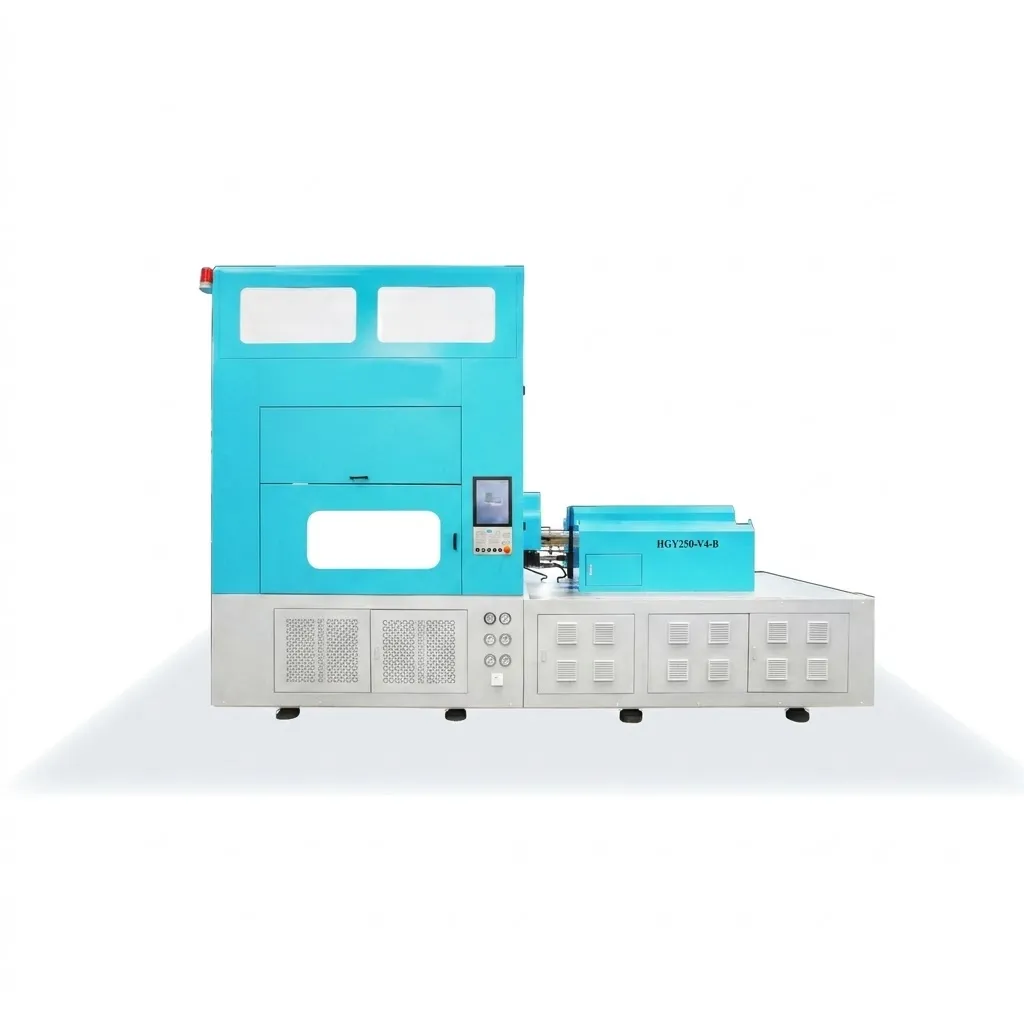
HGY250-V4-B — Four-Station ISBM Machine for Food Condiment Production
For food condiment manufacturing operations producing 250ml–1L sauce, condiment, and specialty food packaging across multiple SKUs at Australian commercial volumes, the HGY250-V4-B four-station one-step ISBM machine provides the production flexibility, food-grade PET processing capability, and dispensing neck finish precision that food packaging quality demands. The four-station rotary architecture delivers consistent cycle-to-cycle process uniformity — critical for food-grade production where process parameter deviation can affect acetaldehyde generation and food safety compliance. The machine processes standard food-grade PET and food-contact PETG with equal precision, and accommodates the range of condiment closure neck finishes — flip-top dispensing spouts, disc-top closures, sports caps, and wide-neck honey jar finishes. PLC-based process logging provides the production traceability record that FSANZ compliance documentation and retailer quality audits require. rPET food-grade blends at 25–30% are processable with adaptive injection profiling.