
1. The Australian Sustainability Imperative: Why Efficiency Is Now a Commercial Requirement
Three structural forces are converging in 2025 to make energy and material efficiency in packaging production non-negotiable for Australian manufacturers. First, the APCO National Packaging Targets require 100% of packaging to be recyclable, compostable or reusable by 2025 and mandate significantly increasing recycled content — these targets are now enforced through annual reporting obligations directly linked to retail partner listing agreements at Woolworths, Coles, Chemist Warehouse and major pharmacy chains. Second, mandatory Australian Sustainability Reporting Standards (ASRS) climate disclosure requirements bring Scope 1, 2 and 3 emissions from manufacturing operations under public reporting for large entities from 2025 and medium-sized entities from 2026. Third, energy cost escalation across the National Electricity Market — particularly acute in South Australia and Queensland — elevates power consumption per unit produced to a first-tier cost management variable rather than a secondary operational consideration.
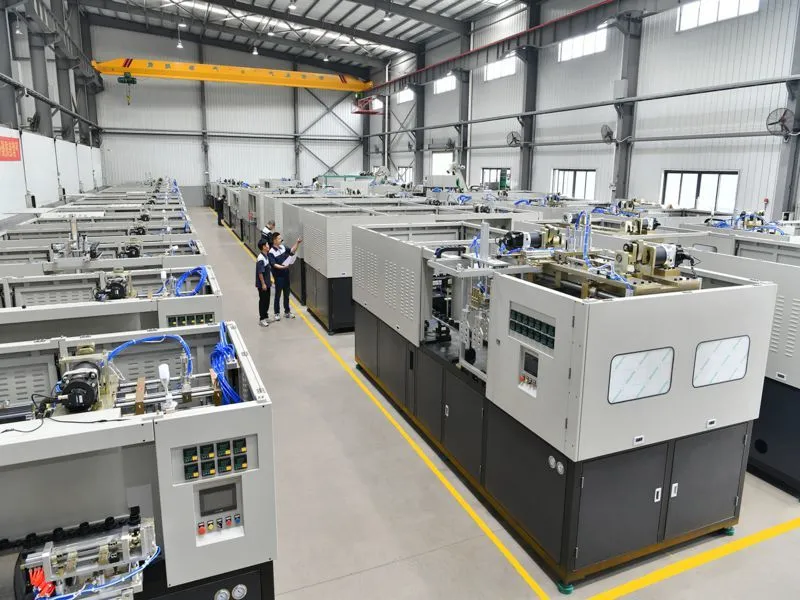
の automatic blow moulding machine platform of one-step ISBM addresses all three forces simultaneously: 20–30% lower energy consumption per container than two-step reheat processing, 95%+ material utilisation with near-zero process waste, and mono-material PET container architecture that is 100% kerbside-recyclable under Australia’s existing collection infrastructure. This is not a combination of benefits available from any alternative container production technology at comparable capital cost and operational complexity.
This article quantifies every sustainability claim with engineering precision — where the energy savings originate in the thermodynamic cycle, how 95%+ material utilisation is achieved and sustained in production, what the downstream carbon footprint implications of lightweighting are across the distribution chain, and how the recyclability profile of ISBM-produced mono-material PET containers aligns with Australia’s emerging recycled content and collection infrastructure requirements under the 2025 targets and beyond.
2. The Thermodynamic Basis for 20–30% Energy Savings Over Two-Step Processing
2.1 Where Two-Step Processing Wastes Energy
In two-step injection reheat stretch blow moulding, a PET preform undergoes a complete thermal cycle across two separate machines: it is heated from ambient resin temperature (approximately 20 °C) to melt temperature (270–290 °C) in the injection press, then cooled from melt temperature to a storage and handling temperature (typically 15–25 °C) after preform ejection and before transfer to the second machine, then reheated from storage temperature to the stretch-blow processing window (95–110 °C) in the reheat oven of the blow moulding machine. The total thermal energy input across this cycle is approximately 180–210 kJ per kilogram of PET processed. Of this, 60–75 kJ per kilogram represents the reheating step from ambient storage temperature to the stretch-blow window — energy that produces no change whatsoever in the molecular structure of the preform, only returning it to a thermal state it previously occupied immediately before the intermediate cooling step. This is pure thermodynamic waste embedded in the process architecture of two-step production, and it cannot be eliminated by any process optimisation or equipment upgrade within the two-step paradigm.
2.2 How One-Step Eliminates the Reheat Penalty
The one-step ISBM process retains the preform at an intermediate temperature after injection — typically 130–150 °C at the core rod surface after the injection cooling phase — and uses the conditioning station to adjust this temperature precisely to the stretch-blow window without first cooling to ambient. The thermal energy input to the conditioning station is therefore only 30–50 kJ per kilogram, compared with 60–75 kJ/kg for the full reheat in two-step processing. The difference — 20–45 kJ per kilogram of PET processed — is the direct thermodynamic source of the 20–30% energy saving, and it is a structural advantage inherent in the one-step architecture that persists regardless of machine vintage, resin grade or container format.
When compounded with the full servo drive system’s 15–25% reduction in machine electrical consumption over hydraulic-servo hybrid drives — achieved by eliminating the constant-pressure hydraulic circuit that runs continuously regardless of whether any actuator is moving — Australia Ever-Power’s fully servo PETボトル成形機 EV series achieves total energy consumption per thousand containers that is 35–55% below a comparable two-step line with hydraulic drive. This is not an engineering estimate: it is a measured result from factory acceptance testing, and Australia Ever-Power provides the measurement data in the machine delivery documentation.
3. Quantified Energy Savings: Real Numbers for Australian Operations
The table below presents energy consumption comparisons across drive types for a representative 500 mL PET water bottle production scenario, calculated at Australian electricity tariffs and a three-shift, 80% utilisation operating schedule. All figures are based on measured machine energy consumption data from Australia Ever-Power factory acceptance test records.
| Metric | Two-Step Hydraulic | One-Step Servo-Hyd | One-Step Full Servo (EV) |
|---|---|---|---|
| Energy / 1,000 × 500 mL PET (kWh) | 18–22 | 13–16 | 10–13 |
| Annual energy cost (10M bottles, AUD 0.22/kWh) | ~AUD 44,000 | ~AUD 32,000 | ~AUD 25,000 |
| Annual CO₂ saving vs two-step (SA grid, 0.4 kg/kWh) | Baseline | ~24,000 kg | ~38,000 kg |
| Operators required per shift | 3~5 | 1 | 1 |
| Annual labour saving vs two-step (AUD 24.10/hr, 3 shifts) | Baseline | ~AUD 180,000 | ~AUD 180,000 |
* Based on representative 10M × 500 mL PET water bottle production. SA grid carbon factor 0.4 kg CO₂/kWh (2024 NGA Factors). Labour saving calculated at 2 fewer operators per shift × 3 shifts × 250 working days × 8 hours × AUD 24.10/hr. Actual values vary by machine model, product format and operating schedule.
4. Material Utilisation Above 95%: The Engineering Basis
The 95%+ material utilisation claim for one-step ISBM is grounded in a simple but important architectural distinction from alternative container production processes. In extrusion blow moulding (EBM), the process produces a parison — an extruded tube captured by the blow mould, blown into shape and then trimmed. The top-and-bottom flash from the parison, plus the pinch-off tail, typically represents 10–20% of the total extruded material weight cut away after blowing and sent to regranulation. In injection stretch blow moulding, there is no trim or flash in the conventional sense: the hot-runner injection system delivers precisely metered shots of melt to each preform cavity with no runner material to remove, and the preform contains exactly the material that will constitute the finished container. The only “waste” is the gate vestige at the container base — typically 0.05–0.15 g per container — which accounts for less than 1–2% of total container weight for standard formats. Material utilisation of 95%+ is therefore the natural result of the ISBM process architecture, not an optimisation achievement.
What is an optimisation achievement — and one that meaningfully differentiates Australia Ever-Power’s servo-controlled injection unit from hydraulic competitors — is shot weight accuracy. The servo-controlled injection unit of the ワンステップ射出延伸ブロー成形機 EV series maintains injection volume repeatability within ±0.1 g per cycle across the full production shift. This precision allows production engineers to set the target shot weight at precisely the container specification weight rather than adding a safety margin above nominal to prevent short shots — a practice that wastes 1–3% of total resin consumption producing containers heavier than the specification requires, purely as insurance against injection variability.
Across a production run of 10 million containers at an average shot weight of 12 g, eliminating a 2% safety margin by virtue of servo injection precision saves 2,400 kg of PET resin annually. At current Australian food-grade PET prices of AUD 1.80–2.20 per kilogram, this represents AUD 4,300–5,300 in direct material cost avoidance per year per machine — before any consideration of the reduced carbon footprint from lower virgin polymer consumption and the APCO reporting benefit of a lower packaging weight per unit sold.
5. Lightweighting: The Compounding Sustainability Multiplier
Lightweighting — reducing the gram weight of a container while maintaining or improving its functional performance specification — is one of the most powerful tools available for reducing the lifecycle carbon footprint of plastic packaging, and it is enabled structurally by the biaxial molecular orientation that the ISBM stretch-blow process creates. Oriented PET has more than 30% higher tensile strength than unoriented PET of the same grade — meaning the same functional container performance (top-load strength, burst pressure, sidewall stiffness) can be achieved with proportionally less material. In commercial practice, ISBM enables container gram weights 15–25% lower than equivalent non-oriented containers produced by injection blow moulding or extrusion blow moulding at the same performance specification.
Lightweighting Impact Across the Supply Chain
Manufacturing
Less resin consumed per unit → lower Scope 1 & 2 emissions
Distribution
Lower filled product weight → fewer truck movements → Scope 3 reduction
Retail
Lower pack weight → APCO packaging weight per unit benefit
End of Life
Less material in recycling stream → lower MRF processing energy
Australia Ever-Power’s full servo stretch rod control enables stretch ratio optimisation across the entire container height profile — maintaining material where structural analysis confirms it is required (base gate area, sidewall midpoint, shoulder transition) while reducing wall thickness where it is not — achieving the minimum viable wall design without the scrap rate penalties that hydraulic systems produce at low injection speeds and thin wall sections. The digital twin process modelling capability available on EV series machines allows preform wall thickness profiles to be optimised computationally before tooling is cut, eliminating the iterative physical trials that previously made lightweighting projects slow and expensive.
6. rPET Processing: One-Step ISBM’s Structural Compatibility Advantage
Recycled PET (rPET) is increasingly mandated or incentivised in Australian beverage packaging under APCO targets and voluntary brand commitments from major FMCG companies. Processing rPET at commercial scale presents a specific technical challenge for two-step reheat blow moulding lines: rPET has different near-infrared (NIR) absorption characteristics compared to virgin PET, which means the reheat oven calibration — set for a specific NIR absorption profile — must be recalibrated for every change in rPET blend percentage or source material origin. This creates process variability that increases defect rate and reduces the practical usable rPET concentration in commercial production below what the material specification would technically permit, because operators build in safety margins against absorption variability that manifest as over-heated and under-heated preforms within the same production run.
One-step ISBM processes rPET through a melt temperature-controlled barrel where NIR absorption characteristics are entirely irrelevant — the material is heated to the target melt temperature regardless of its NIR absorption profile, and the conditioning station provides temperature management based on measured preform temperature rather than NIR-derived inference. This makes one-step ISBM architecturally more tolerant of rPET feedstock variability, enabling commercial production at rPET blend percentages of 25–100% without the process recalibration overhead that two-step lines incur at each blend change.
For Australian brands committed to increasing rPET content in their packaging under APCO targets and voluntary pledges — a category that now includes virtually every major beverage, FMCG and household chemical brand with a significant retail presence — this rPET processing advantage makes the switch from a two-step line to an Australia Ever-Power automatic blow moulding machine platform a sustainability enabling decision, not merely a capital replacement decision.
7. APCO Compliance, ASRS Reporting and ACCU Generation
7.1 APCO Annual Packaging Report Inputs
Australia Ever-Power provides lifecycle assessment (LCA) input data for all machine models, including measured energy consumption per thousand containers produced at the commissioning stage, documented in the factory acceptance test report. This data is the direct input for the packaging manufacturing energy intensity figures required in APCO annual packaging reports, using the relevant state grid emission factor from the NGA Factors (National Greenhouse Accounts Factors) published annually by DCCEEW. For manufacturers operating in South Australia — where the NEM grid carbon intensity is among the lowest in Australia due to high renewable penetration — the combination of one-step ISBM energy efficiency and the low grid carbon factor produces particularly compelling Scope 2 emissions figures for APCO reporting.
7.2 ASRS Mandatory Climate Disclosure
Under the Australian Sustainability Reporting Standards (ASRS 1 and ASRS 2), large entities — defined as those meeting at least two of the criteria: consolidated revenue ≥ AUD 500M, consolidated gross assets ≥ AUD 1B, or employees ≥ 500 — are required to disclose Scope 1, 2 and 3 emissions from the 2025–26 financial year. Medium-sized entities follow from 2026–27. For packaging manufacturers subject to ASRS reporting, the machine-level energy consumption data from Australia Ever-Power’s factory acceptance test provides the verified input for the Scope 2 emission calculation at the packaging manufacturing facility — a figure that is directly auditable against the machine’s electronic batch record system log, providing the evidentiary trail that ASRS requires for verified disclosure.
7.3 Australian Carbon Credit Units (ACCU) Generation
For operations switching from a two-step hydraulic blow moulding line to a one-step full servo ISBM platform, the measured energy reduction — verifiable from the machine’s data logging system against the documented two-step baseline — may generate Australian Carbon Credit Units (ACCUs) under the Carbon Credits (Carbon Farming Initiative) Act 2011 energy efficiency project methodology. At current ACCU spot prices of AUD 30–40 per tonne of CO₂-equivalent, a manufacturing operation producing 38,000 kg CO₂ reduction annually (as shown in the table in Section 3) could generate ACCUs with a market value of AUD 1,140–1,520 per year — modest in absolute terms relative to the energy cost saving, but a genuine, verifiable additional financial return on the sustainability investment. Australia Ever-Power recommends engaging an accredited carbon project developer before machine commissioning to assess ACCU eligibility, as the baseline measurement methodology must be established before the new machine commences operation.
8. Calculating Your Sustainability ROI: A Practical Framework
The sustainability case for switching to one-step ISBM is compelling in isolation. The financial return on that sustainability investment should be modelled as part of the capital expenditure justification — not treated as a separate “environmental” decision divorced from the business case. The sustainability ROI framework for one-step ISBM covers four distinct value streams, each quantifiable with data available before the machine purchase decision.
⚡
Direct Energy Cost Saving
AUD 7,000–19,000 per year versus two-step processing, depending on machine size and operating schedule. Calculated from measured energy consumption and local electricity tariff. Fully quantifiable before purchase.
🧴
Material Cost Saving
AUD 4,300–5,300 per year from shot weight accuracy improvement (±0.1 g servo vs ±0.3–0.5 g hydraulic) eliminating over-weight safety margin. Plus elimination of EBM trim waste for operations converting from extrusion blow moulding.
👷
Labour Cost Saving
AUD 150,000–200,000 per year from reduction in required operators per shift from 3–5 (two-step) to 1 (one-step), at Australian minimum wage and on-costs. Single largest financial contributor in the Australian labour cost environment.
🌱
Carbon Price Exposure Reduction
ACCU generation potential AUD 1,000–1,500 per year based on current ACCU spot prices. Growing in value as ASRS disclosure obligations expand and voluntary carbon market matures. APCO compliance maintenance value in retail listing protection.
Australia Ever-Power provides a complimentary Sustainability ROI Report with every machine quotation, populated with the buyer’s specific production data, electricity tariff, resin costs and current machine type inputs. The report models all four value streams over a 10-year horizon, providing the documented financial justification for the capital expenditure approval process alongside the environmental and compliance narrative — because in 2025, sustainability decisions that cannot demonstrate a positive financial return within a reasonable payback period do not survive internal capital allocation review, regardless of how compelling the environmental case is.