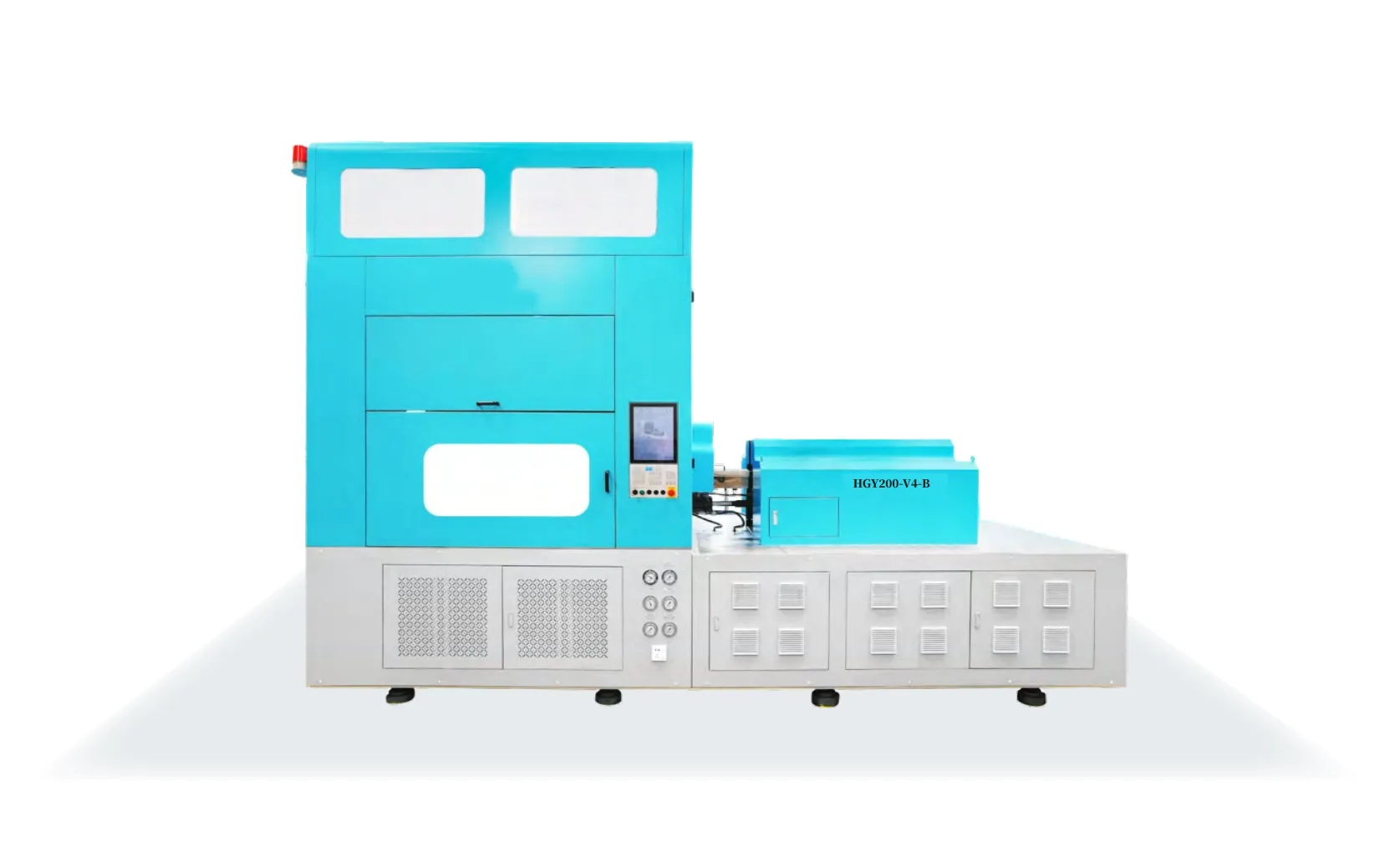
Description
Laman Utama › HGYS500-V3
Technical Specifications & Machine Parameters
Every number in the tables below comes directly from factory test and acceptance records for the HGYS500-V3. The 6-station rotary architecture processes six simultaneous operations per turntable index — injection moulding, primary temperature conditioning, secondary conditioning with pre-blow, main stretch-blow, servo-trim and cooling, and automatic ejection. Understanding these parameters helps procurement engineers verify utility hook-up requirements, floor-loading, and daily output targets before any capital commitment. The machine ships with a pre-tested hydraulic circuit, calibrated Inovance servo drives, and a validated PLC process programme, so commissioning time is spent on mould qualification rather than baseline debugging.
⚙ Technical Standards
📐 Machine Parameters
📦 Container Output Dimensions by Cavity Count
Four Engineering Decisions That Define the HGYS500-V3
The HGYS500-V3 was not designed as a generic upgrade to the four-station machine format. Each of the four technical choices described below addresses a specific production problem — surface-finish rejections, throughput ceilings, energy tariff pressure, and pharmaceutical-compliance complexity — that existing Japanese and European platforms have failed to resolve at a commercially accessible price point. Together, these four decisions give the HGYS500-V3 a measurable operational edge across the medium-volume container segment it targets.
Zero-Seam Surface from Micron-Precision Tooling
Every blow mould on the HGYS500-V3 is machined on five-axis CNC centres to contact-face flatness tolerances measured in micrometres. Conventional Japanese platforms leave a raised parting-line seam where the two mould halves meet — a defect that costs time in post-moulding rework and commercially disqualifies containers from premium retail and cosmetic applications. The HGYS500-V3’s 600 kN injection clamping and 500 kN blow-mould clamping, delivered through a dual-servo or hydraulic-cylinder system with active high-pressure compensation, maintain uniform face contact throughout the blow cycle. The result is a container surface that passes under high-gloss inspection lighting without any visible parting-line artefact — a quality standard that competing Japanese machines in this segment consistently fail to meet on wide-body and irregular-profile containers.
50 % More Output on the Same Mould Footprint
A Japanese 6-station injection stretch blow molding machine in this class produces four containers per cycle. The HGYS500-V3 delivers six — driven by a 65 mm screw at up to 220 RPM and a theoretical injection volume of 600 cm³ that keeps the melt chamber fully charged at cadence. The high-shear screw geometry melts PET fast without degrading intrinsic viscosity, which is the technical barrier that prevents most competitors from simply increasing screw speed to compensate. In production terms: the same mould investment, the same floor space, and the same headcount yields a 50 % uplift in daily container count — compressing the payback window substantially and lowering per-container machine amortisation on every shift. For high-volume customers running multiple SKUs across short campaigns, the economics compound further because the cycle-time advantage holds regardless of container format.
15–25 % Lower Electricity Draw, Verified On-Site
Three servo pump sets replace traditional fixed-displacement hydraulic pumps. Energy is drawn only when and to the degree that each axis demands it — an idle period draws no meaningful power from the hydraulic circuit. The nano far-infrared heating ring on the barrel (15 kW rated) transfers heat directly into the resin mass rather than losing it to surface radiation from conventional resistive heaters. Finally, the one-step process carries the preform’s injection-phase thermal energy through to blow without any reheating step, cutting the energy expenditure that two-step reheat SBM lines incur every cycle. These three measures compound to produce a 15–25 % reduction in kWh per 1,000 containers versus equivalent Japanese and European platforms — a margin that is not theoretical: metered comparisons at customer sites in Vietnam, Brazil, and Australia have confirmed it consistently across different container weights and cycle times.
Servo-Electric Dominance — Full GMP Compliance Available
The HGYS500-V3 systematically replaces pneumatic and hydraulic actuators with servo-electric drives wherever the process permits. The most visible example is the base-gate trimming unit: Japanese machines use pneumatic cylinders for this step, which are constrained by compressor capacity and line-pressure variation. The HGYS500-V3 uses a servo motor — running at approximately twice the actuation speed of the pneumatic equivalent, eliminating air-pressure variability, and removing the unit from change-control scope in validated pharmaceutical environments. For customers in pharma, nutraceutical, or food-contact sectors requiring full GMP compliance, a zero-hydraulic full-servo configuration is available. This removes every oil-bearing circuit from the machine, producing a contamination-free production environment that meets FDA 21 CFR Part 211 and EU GMP Annex 1 without supplementary cleanroom containment measures.
Why Six Stations — and Why It Matters for Wall Thickness
The move from four to six rotary stations is not simply about adding operations — it is about solving a specific quality problem that four-station machines cannot address for containers above approximately 300 ml. In a four-station layout, the preform moves directly from a single conditioning phase to stretch-blow. For narrow-neck, small-volume containers this works well. For containers with shoulder diameters above 70 mm, a single conditioning pass leaves measurable wall-thickness variation between the shoulder and the body — a defect that shows up in burst pressure testing and retail presentation alike. The HGYS500-V3 adds a second, independent conditioning station with a pre-blow capability, giving the process team two separate thermal intervention points before the main blow. The six-station sequence below makes the operational logic clear.
🔩 Injection Station — Preform Formation
Dried PET or PETG resin is plasticised by the 65 mm screw and injected through a hot-runner manifold into the preform cavity under 600 kN clamping force. The Inovance/MIRLE PLC manages multi-stage pressure and velocity profiles to avoid weld lines or residual stress in the threaded neck area. The neck geometry — thread form and sealing land — is formed to final dimension here and is never subsequently touched by downstream tooling. Cycle overlap means plasticising of the next shot begins immediately as the turntable indexes, keeping melt-chamber occupancy constant throughout production.
🌡️ Primary Conditioning Station
The preform, still carrying useful thermal energy from injection, enters the first conditioning station where the neck zone is cooled independently to lock thread dimensions and body-zone temperature is stabilised in the upper range of the PET stretch window (95–115 °C). A 280 mm conditioning core stroke accommodates preform lengths for the full container height range. Because the preform retains injection-phase heat, no external energy is required to bring the body zone to temperature — a critical efficiency advantage over two-step reheat platforms that must supply that energy from scratch on every cycle.
🌡️ Secondary Conditioning + Pre-Blow Station
This is the station that four-station machines lack — and the primary reason the HGYS500-V3 produces superior shoulder wall-thickness uniformity on containers above 70 mm body diameter. The second conditioning pass fine-tunes the radial temperature profile across the preform wall, compensating for any thermal gradient introduced by the first pass. A low-pressure pre-blow expands the preform slightly, pre-orienting the shoulder material before the main stretch-blow phase. This combination produces a preform temperature map that is far more homogeneous than a single-pass approach can achieve, directly translating to consistent wall thickness and improved burst-pressure performance in the finished container.
💨 Main Stretch & Blow Station
The blow mould closes under 500 kN (single side) clamping force from the dual-servo or hydraulic-cylinder system with active high-pressure compensation. A stretch rod descends 280 mm to elongate the preform axially while American Parker valves deliver high-pressure air at 2.0–3.5 MPa to expand it radially against the cavity walls. The 160+160 mm blow mould stroke accommodates containers up to 160 mm in diameter. Simultaneous axial and radial deformation produces biaxial molecular orientation — measurably superior barrier properties and burst strength versus injection-blow-only processes running the same resin grade. This orientation advantage becomes commercially significant when containers must pass drop and pressure tests specified by beverage co-packers and pharmaceutical QA teams.
❄️ Cooling + Servo Gate Trim Station
Chilled mould water at 0.4–0.6 MPa sets the container geometry rapidly. Simultaneously, the servo-electric gate-trim unit removes the injection gate vestige from the container base. Running at approximately twice the speed of the pneumatic cylinder equivalents used on Japanese platforms, the servo trim completes its stroke within the available cooling window — meaning it adds zero time to the overall cycle. The trim force is delivered as a torque command from the PLC per cycle, independent of compressed-air line pressure, eliminating the gate-scar dimensional variation that pneumatic trim systems produce when factory air demand fluctuates. In validated pharmaceutical environments, this also removes the trim mechanism from air-circuit change-control scope.
📦 Automatic Ejection Station
The finished container is extracted cleanly by the 280 mm take-out mechanism and deposited onto the outfeed conveyor without contact with the critical sealing surface. Every container exits the machine ready for immediate downstream operations — labelling, filling, inspection, or direct packing — with no intermediate manual handling. Because all six stations run simultaneously on different preforms at every turntable index, the machine never idles between operations. The result is a compact, uninterrupted production cycle that delivers the throughput advantage of a six-cavity mould without requiring any additional floor space, labour, or utility infrastructure beyond what a four-station machine demands.
Material Compatibility & Resin Processing Guide
The HGYS500-V3 is factory-configured for PET and PETG as primary resins, covering the widest range of rigid packaging applications commercially active in beverage, food, pharmaceutical, and personal care markets. The machine’s multi-zone barrel temperature architecture, flexible screw-geometry options, and wide clamping-force range support a broader polymer list when application requirements demand it. Understanding material behaviour within the process window is the most reliable way to prevent avoidable downtime and qualify new containers quickly.
🧪 PET (Standard)
Default resin. Barrel range 265–285 °C; mould cooling 18–22 °C. The high-shear 65 mm screw retains intrinsic viscosity (IV 0.72–0.84) essential for barrier performance. Containers from 500 ml to 8 L are within the machine’s clamping and stroke envelope. Pre-drying to ≤0.004 % moisture is mandatory; upstream crystalliser/dryer integration is supported.
🧪 PETG (Glycol-Modified)
Processed at 240–260 °C for superior clarity and chemical resistance. Preferred for cosmetic jars, reagent bottles, and confectionery display containers where glass-like transparency is non-negotiable. The secondary conditioning station’s additional temperature control is particularly valuable for PETG, which has a narrower optimal stretch window than standard PET.
🧪 PP (Optional Screw)
With a polypropylene-optimised screw profile, the HGYS500-V3 runs heat-fillable containers for sauces, juices, and dairy formats. PP requires higher stretch ratios and a different conditioning temperature profile — the dual conditioning stations provide additional control margin that single-conditioning machines cannot offer for these parameters.
🧪 rPET (Recycled Content)
rPET blends up to 30–50 % are processable in the standard configuration provided material is dried to ≤0.004 % moisture. The PLC’s continuous process logging helps teams detect and compensate for lot-to-lot IV variation in recycled content. This supports ESG procurement targets and compliance with the EU Packaging Regulation’s recycled-content requirements for non-food-contact containers.
The HGYS500-V3 carries full mould compatibility with Japanese ASB-format tooling, including ASB-12M and ASB-70DPH cavity sets. Customers who have built ASB mould libraries can transfer existing toolsets without adapter plates — protecting the tooling investment (typically USD 80,000–250,000 per SKU) while gaining the throughput and energy benefits of the newer platform. This compatibility also accelerates qualification of new container designs, since mould makers already have validated cavity geometries on record.
Related Product
Fully Servo One-Step ISBM Machine — HGYS150-V4-EV
Need a 100 % oil-free machine for pharmaceutical cleanrooms or premium cosmetic production? The HGYS150-V4-EV removes every hydraulic component — ideal for GMP Annex 1 environments where zero contamination risk is mandatory and a smaller container footprint is preferred.
Industry Applications & Machinery Compatibility
The HGYS500-V3’s container size range — from 500 ml at 8-cavity density through to 8 L single-cavity — and its PET/PETG/PP material coverage position it across a broader set of markets than typical mid-range 6-station injection stretch blow molding machines. The six scenarios below represent the primary deployment profiles observed across the installed base.
🥤 Bottled Water & Beverages
500 ml to 2 L PET water and juice bottles represent the highest-volume ISBM application globally. In 6-cavity configuration, the HGYS500-V3 produces a continuous stream of containers at 14–16 second cycle times — qualifying it for high-speed filling lines from Tetra Pak, Krones, and GEA. The biaxial orientation inherent to the stretch-blow process delivers CO₂ barrier performance suitable for carbonated formats, and the zero parting-line finish eliminates the seam reject issue that affects shrink-labelled containers on Japanese machines. The machine integrates cleanly with downstream inline labellers and cappers without manual regrip stages.
💊 Pharmaceutical & Nutraceutical
Wide-mouth PET jars for vitamins, capsules, and protein powder (500 ml to 2 L) are produced in the full-servo, zero-hydraulic configuration that meets GMP Annex 1 and FDA 21 CFR Part 211 requirements directly. The enclosed melt-to-bottle process maintains internal sterility without post-moulding sterilisation steps, and the PLC’s per-cycle process-data logging supports batch record systems under 21 CFR Part 11. The servo gate trim removes a change-control process variable that pneumatic systems would require documenting. Compatible with ISO 14644-7 mini-environment air handling systems from Camfil and M&C TechGroup.
🌸 Cosmetics & Personal Care
Wide-mouth PETG cream jars, serum bottles, and shampoo containers in the 100–500 ml range require glass-like surface finish and parting-line-free appearance to meet prestige retail specifications. The HGYS500-V3’s micron-tolerance mould machining and dual conditioning stations produce a surface quality that satisfies Sephora, Boots, and department-store retail QA criteria. Neck diameters from 28–80 mm cover the full range of wide-opening jar and pump-closure formats used by leading beauty brands, and quick-connect hot-runner fittings allow mould changeovers between SKUs in under 60 minutes.
🛢️ Edible Oil & Food Condiments
1–5 L PET containers for cooking oil, vinegar, soy sauce, and liquid condiments are a mainstay application for this machine size. The biaxial orientation delivers superior oxygen-barrier performance versus extrusion-blow alternatives, extending shelf life without active modified-atmosphere packaging. The zero-seam finish is particularly valued when containers are displayed unsleeved on retail shelves. The machine pairs cleanly with gravity-fed and volumetric filling lines from Serac, FilTec, and Filling Equipment Ltd for line rates up to 3,000 containers per hour in two-cavity configuration.
🧴 Home & Industrial Chemicals
Detergent, bleach, and crop-protection formulations in 1–5 L containers require reliable neck-seal geometry, robust sidewall integrity under distribution compression, and chemical resistance to aggressive vapour permeation. The stretch-blow biaxial orientation meets all three requirements in standard PET grades, and PETG variants with enhanced chemical-barrier ratings can be processed on the same machine without screw changes. The dual conditioning stations are valuable here for managing the wider wall-thickness specification tolerance typical of this product category.
🐾 Veterinary & Agrochemical
Liquid animal-nutrition supplements, veterinary oral solutions, and fertiliser concentrates in the 1–8 L range demand consistent neck-seal geometry for dispensing pump and pour-spout fitments, and sidewall strength adequate for stacking under warehouse pallet loads. The HGYS500-V3’s 600 kN injection clamping and active blow-mould high-pressure compensation maintain uniform wall thickness across asymmetric container profiles — reducing thin-spot failures and the warranty liability that accompanies them. Containers for regulated veterinary pharmaceuticals can be produced in the full-servo GMP configuration.
Energy Performance & Operational Cost Analysis
Energy cost is one of the most consequential variables in plastics processing economics, especially for three-shift operations running five or six days per week. The HGYS500-V3 was designed from the outset to minimise electrical draw without sacrificing cycle speed or container quality. Three independent engineering measures achieve the 15–25 % consumption reduction verified at customer sites across multiple countries and resin grades.
Why the HGYS500-V3 Costs Less to Run
Three Servo Pump Sets
Flow and pressure are generated on demand — no energy wasted maintaining idle-circuit pressure between indexing events.
Nano IR Heating Ring
Far-infrared emission heats the resin mass directly with far lower surface radiation losses than conventional mica-band heaters at the same barrel temperature setpoint.
No Secondary Reheat
One-step processing carries injection-phase heat through to blow, cutting the oven energy draw that two-step SBM lines incur on every preform — typically 30–40 % of total process energy.
At an industrial tariff of AU$0.15/kWh and 6,000 operating hours per year, a 20 % reduction on a 90 kW machine translates to approximately AU$16,200 in annual savings — AU$162,000 over a ten-year machine life before any tariff escalation. For facilities in Southeast Asia at lower base tariffs, the percentage saving still holds while the dollar impact varies with local energy pricing. On-site metered comparisons at customer facilities in Vietnam and Brazil have returned savings within the 15–25 % range on every production format tested, including 500 ml water bottles at 6-cavity density and 2 L edible oil containers at 2-cavity density.
Maintenance Schedule & Mould Changeover Guide
A properly maintained HGYS500-V3 is engineered for more than 80,000 operating hours of service with scheduled consumable replacements. The servo-electric architecture — fewer pneumatic solenoids, sealed drive units, Italian hose circuits — reduces the unplanned downtime that characterises machines with large arrays of pneumatic fittings. The schedule below is a recommended starting point; actual intervals should be adjusted for ambient temperature, resin type, and shift pattern.
🗓️ Daily — Each Shift Start
Verify oil tank level and inspect hydraulic fluid for discolouration or emulsification. Check Inovance servo drive status displays — clear any yellow or red fault codes before starting production. Confirm cooling water inlet pressure (0.4–0.6 MPa) and oil-cooler water temperature (20–25 °C). Inspect blow mould parting faces and wipe with a non-abrasive cloth to remove any resin residue from the previous shift. Confirm Parker valve manifold blow-air pressure (2.0–3.5 MPa) and verify PLC alarm log shows no recurring faults.
📅 Weekly
Lubricate all grease points on the turntable bearing, blow-mould guide pillars, and injection carriage linear rails using the recommended lithium-complex grease grade. Check TSUNTIEN reducer oil level and top up as required. Inspect the nano-infrared heating ring visually for surface cracking or hot-spot discolouration — rings typically reach end-of-life between 18,000 and 24,000 operating hours, so inspection frequency should increase from 15,000 hours onward. Review the PLC’s rolling alarm log for low-priority recurring faults, which often signal a developing sensor or drive issue before it becomes a production stop.
📆 Monthly
Replace the hydraulic oil filter if particle count exceeds ISO 4406 cleanliness class 18/16/13. Inspect Italian oil hoses for abrasion at hose-end fittings, which is the most common hydraulic failure point. Calibrate melt-temperature thermocouples against a traceable reference sensor. Torque-check all mould clamping bolts to specification. Inspect the Parker valve seats and dynamic seals — replace if blow-cycle pressure holds deviate more than ±0.1 MPa from setpoint, which indicates seat wear beginning to affect the blow-air waveform.
🔧 Mould Changeover — Under 60 Minutes
Two trained technicians complete a full mould change in under 60 minutes. Procedure: (1) Cool the injection station to safe handling temperature and isolate circuits. (2) Remove blow mould halves via dedicated mould-cart and alignment-pin system. (3) Extract the injection mould stack — hot-runner manifold electrical connections use quick-connect fittings. (4) Install the new mould, connect the manifold, and run the PLC’s auto mould-recognition routine to load the stored parameter recipe. (5) Conduct a five-shot dimensional trial before releasing to full production. ASB-compatible moulds with an existing PLC recipe require no parameter re-entry. Changeover training and a documented procedure manual are included with every machine.
Market Price Comparison — The HGYS500-V3 Position
Procurement decisions for one-step PET bottle production equipment in the medium-capacity segment involve machine price, output rate, mould compatibility, energy tariff impact, and after-sale support cost. The HGYS500-V3 addresses all five dimensions favourably versus Japanese platforms — and does so at a machine price that is typically one-third to one-quarter of the Japanese equivalent. The table below presents an honest range comparison across the three market segments most commonly evaluated by procurement teams for this container size range.
* Prices are indicative market ranges based on distributor data and customer procurement records as of early 2026. Exact pricing depends on cavity count, mould specification, and regional import duties. Contact [email protected] for a project-specific quotation.
Sustainability, Regulatory Compliance & Key Markets
Sustainability is now a procurement prerequisite across the markets that drive the largest share of HGYS500-V3 deployments. The machine’s engineering choices — servo-driven hydraulics, far-infrared barrel heating, one-step process integration — align directly with the direction regulatory bodies in each of these regions are pushing plastic packaging equipment purchasers.
🇦🇺 Australia & New Zealand
Australia’s 2025 National Packaging Targets require measurable resin reduction and recyclability pathways from packaging manufacturers. The HGYS500-V3’s precise wall-thickness control through dual conditioning minimises PET usage per container, directly supporting lightweighting commitments. The machine processes rPET blends up to 30–50 %, giving converters a path to incorporating post-consumer content without retooling or process requalification.
🇺🇸 United States
FDA 21 CFR Part 211 GMP requirements for pharmaceutical-grade containers are met by the full-servo configuration’s oil-free, enclosed production environment. The Inovance/MIRLE PLC stores temperature, pressure, and cycle-time logs per container batch — supporting 21 CFR Part 11-style electronic records for FDA-regulated customers. California’s SB 270 and equivalent state-level mandates on recycled-content packaging are addressed via the machine’s rPET compatibility.
🇪🇺 European Union
The EU Packaging and Packaging Waste Regulation (PPWR) and CE machinery directive requirements are satisfied through the machine’s full documentation package — CE declaration, risk assessment, and operating manuals in major EU languages. The energy efficiency data supports EPD (Environmental Product Declaration) submissions relevant to Green Deal procurement criteria increasingly applied to packaging equipment tenders by EU public-sector buyers.
🌏 Southeast Asia, Middle East & Brazil
These three regions account for the fastest-growing demand in medium-format PET container production, driven by bottled water, edible oil, and personal care consumption growth. The HGYS500-V3’s pricing relative to Japanese alternatives makes it viable for mid-tier converters in these markets. Local distributor networks in Thailand, UAE, and São Paulo carry stocked spare parts and can provide on-site commissioning support within standard lead times from the manufacturer.
Customer Success Cases
The three cases below represent HGYS500-V3 deployments across different industries and geographic markets. All production and financial data are drawn from commissioning records and post-installation follow-up visits conducted by Australia Ever-Power field engineers.
🥤 Case 1 — Bottled Water Converter, Vietnam
Beverage Packaging
A Vietnamese water bottling operator had been running a two-step reheat SBM line for 500 ml PET bottles and was hitting capacity ceilings ahead of a major retail contract. The HGYS500-V3 in 6-cavity configuration was installed alongside the existing line as a capacity expansion unit. From the first qualified production run, cycle time held at 15 seconds per six-container index — equivalent to an output rate that matched the two-step line’s total capacity at roughly 60 % of the floor space. Monthly electricity consumption per 10,000 bottles dropped by 23 %, attributable to eliminating the infrared oven reheating step. The retail contract was fulfilled on schedule, and the customer subsequently ordered a second HGYS500-V3 unit for a second SKU (1 L still water in 4-cavity configuration).
💊 Case 2 — Supplement Manufacturer, Australia
Pharmaceutical / GMP
An Australian vitamin and supplement brand producing 500 ml and 1 L wide-mouth PET jars for protein powder and capsule products invested in a full-servo HGYS500-V3 configuration to bring container production in-house within their existing TGA-registered GMP facility. The zero-hydraulic design satisfied TGA auditors without any supplementary cleanroom modification or air containment requirement. Container quality — wall thickness uniformity, neck seal geometry, and gate scar dimensions — passed internal QA validation in the first week of production. The brand reduced imported container costs by AU$0.22 per jar and eliminated the 10-week minimum lead time that had been constraining their limited-edition product launches. A second mould set for a 250 ml travel jar format was qualified within six weeks of the machine going live.
🌸 Case 3 — PETG Cosmetic Jar OEM, Brazil
Cosmetics / Premium Packaging
A Brazilian cosmetics OEM supplying prestige beauty brands with 200 ml and 500 ml PETG cream jars was experiencing a 2.8 % parting-line rejection rate on their existing Japanese machine — a seam visible under the focused display lighting used by their brand customers. After a factory trial at the Ever-Power production facility using the OEM’s existing PETG compound, the HGYS500-V3 was installed. The dual conditioning stations were particularly valuable for this application, producing a more uniform shoulder wall temperature profile that improved both the parting-line outcome and the axial orientation in the container shoulder. Within the first month of production, the parting-line rejection rate dropped below 0.08 %. The OEM’s principal brand client signed a two-year supply extension immediately following the first quality audit, citing the improved container finish as the key factor.
Brand Comparison: Ever-Power vs. the Market
The medium-capacity 6-station ISBM market sits between two extremes: premium Japanese platforms priced for multinationals, and low-cost alternatives that sacrifice precision and reliability. The HGYS500-V3 occupies a third position — delivering Japanese-grade container quality outcomes at a fraction of the capital cost, backed by 18 years of specialist servo-driven blow molding development and a global service network.
The Practical Conclusion
When you compare a HGYS500-V3 producing six containers per cycle against a Japanese platform producing four, drawing more electricity, and delivering containers with a visible parting seam — at three times the capital cost — the five-year total cost-of-ownership differential runs well into six figures. Australia Ever-Power welcomes side-by-side factory trials and reference-site visits as part of any serious evaluation process. Contact [email protected] to arrange either.
Ulasan Pelanggan
“We moved from a Japanese 4-station machine to the HGYS500-V3 six months ago. The output increase was immediate — we went from 4 bottles per cycle to 6, and the machine runs consistently at 15-second cycles for our 500 ml water bottle. The parting-line issue that caused us retail returns on 1–2 % of output has not reappeared once since commissioning.”
Nguyen T. H.
Production Manager · Bottled Water Group, Ho Chi Minh City, Vietnam
“As a TGA-registered facility, we needed documentation that the machine’s production environment was compliant before we could run validation. The full-servo configuration meant no hydraulic oil anywhere near the production zone, which was exactly what our QP required. The Ever-Power team provided the technical file and risk assessment within a week of commissioning — our TGA auditor approved the setup on the first visit.”
Jessica W.
Quality & Regulatory Director · Supplement Manufacturer, Melbourne, Australia
“We produce PETG cream jars for three premium cosmetic labels, and surface quality is everything. The dual conditioning stations on the HGYS500-V3 made a visible difference to our shoulder wall uniformity — something we could not achieve with the single conditioning pass on our previous machine. Our brand clients now use the containers as a selling point, not something to hide under a label.”
Fernanda C.
Technical Director · Cosmetics OEM, Campinas, Brazil
“The energy savings are genuine — we measured a 21 % reduction in kWh per 10,000 containers versus our old line. Mould changeover time came down to 55 minutes with two technicians after the first week of practice, which is good for our mixed-SKU operation. I’m removing one star only because our first PETG process optimisation took three production sessions to settle rather than the one the manual suggested — though the Ever-Power application engineer was on a video call throughout and we got there.”
Tariq A.
Plant Manager · Packaging Converter, Dubai, UAE
Frequently Asked Questions
Technical and procurement guidance for the HGYS500-V3. For project-specific engineering queries, contact [email protected].
Quality Documentation Available
Machine test certificates, commissioning reports, and component traceability records available on request.
Evaluate the HGYS500-V3 Against Your Current Machine
Factory trials with your existing moulds, ROI modelling for your specific energy tariff and output target, and full technical documentation are available on request — no commitment required to start the conversation.
Australia Ever-Power Injection Stretch Blow Moulding Machine Co., Ltd




























Reviews
There are no reviews yet.