Injectable Vial Packaging: The Most Technically Demanding Primary Container Application
Injectable pharmaceutical products — from standard aqueous solutions for intramuscular and intravenous administration through complex biologic formulations including monoclonal antibodies, vaccines, gene therapies, and peptide drugs — are packaged in primary containers that must meet the strictest performance requirements across every dimension of pharmaceutical packaging science. An injectable vial that allows a single microorganism to enter the sterile drug product causes sepsis. A vial whose extractable profile interferes with a complex biologic’s stability causes drug product degradation that may render the product sub-potent or immunogenic. A vial whose rubber stopper does not seat correctly causes headspace oxygen ingress that oxidises oxygen-sensitive APIs. These failure modes — which in each case directly harm the patient — are what the injectable vial’s material, dimensional, sterility, and extractable specifications are designed to prevent.
PET ISBM injection vials occupy a defined niche in this demanding application landscape — appropriate for specific injectable applications where the weight advantage, shatter resistance, dimensional precision, and DEHP-free composition of PET provide clear advantages over glass, but where the autoclave sterilisation limitation of PET (softening at temperatures below the standard 121°C autoclave cycle) requires the use of alternative sterilisation pathways (gamma irradiation or aseptic filling). The máquina de moldagem por injeção, estiramento e sopro produces PET injection vials with the dimensional precision, clean production environment compatibility, and validated process documentation infrastructure that the injectable vial application requires.
Australia Ever-Power Injection Stretch Blow Moulding Machine Co., Ltd, based in Condell Park NSW 2200, supports biologics manufacturers, specialty injectable pharmaceutical companies, and hospital sterile pharmacy compounders with ISBM machine technology and pharmaceutical validation support for PET injection vial production in the TGA regulatory environment.
When PET ISBM Vials Are Appropriate: Application Selection Framework
Not every injectable pharmaceutical application is suitable for PET ISBM vials — the specific constraints of PET, primarily the autoclave incompatibility and the glass adsorption advantage for some biologics, define the applications where PET ISBM provides a genuine advantage versus those where glass remains the superior choice. A systematic application selection framework prevents misapplication of PET ISBM to injectable applications where it is technically unsuitable, and identifies the applications where it provides real commercial and clinical benefits.
| Application Criterion | PET ISBM Suitable | Glass Preferred |
|---|---|---|
| Sterilisation method | Gamma irradiation or aseptic fill | Autoclave 121°C required → Glass |
| Product sensitivity to glass | High: silicone migration, delamination-sensitive biologics | Low: well-characterised in glass, no glass interaction observed |
| Distribution environment | High breakage risk: field use, resource-limited, military medical | Controlled hospital/pharmacy setting: low breakage risk |
| Lyophilisation | Not suitable: vacuum collapse risk | Glass: established lyophilisation primary container |
| DEHP sensitivity | PET: DEHP-free by material class | Glass: DEHP-free (concern is stoppers/tubing, not glass) |
| Weight/logistics | PET: 70–85% lighter at equivalent volume | Glass: heavier — cost to cold chain logistics |
| Protein adsorption | PET: product-specific study required | Borosilicate glass: established low-adsorption reference |
This framework identifies the injectable applications where PET ISBM vials are most compelling: biologics sensitive to glass delamination or silicone lubricant migration from glass vial siliconisation; field-deployed or resource-limited setting injectables where shatter-proof vials prevent contamination from glass fragments; and products with established gamma irradiation compatibility where the sterilisation pathway is not a constraint. For these applications, PET ISBM vials provide a technically superior or commercially competitive alternative to glass that merits the investment in TGA regulatory transition data.
Dimensional Engineering for Injectable Vials: Stopper Seating and Crimp Closure
The dimensional requirements for injectable vial closures — the combination of the vial neck bore, the rubber stopper, and the aluminium crimp cap — are among the most precisely specified in pharmaceutical packaging. The rubber stopper must seat in the neck bore with a defined compression (creating the sealing force that maintains headspace sterility and prevents liquid leakage under the hydrostatic head of the filled solution); the crimp cap must lock the stopper in place under the crimping force of the capping machine without cracking the vial neck or leaving the stopper unseated; and all dimensions must maintain their designed relationship through the gamma irradiation sterilisation cycle and storage at refrigerated to room temperature conditions.
Neck Bore Diameter and Stopper Compression Engineering
The stopper compression percentage — the dimensional interference between the stopper’s nominal OD and the vial neck bore ID, expressed as a percentage of the stopper’s nominal OD — is the engineering parameter that sets the sealing force for injectable vials. Standard injectable vial stopper systems operate at 10–20% compression. For a 13mm neck bore vial with a 13.5mm nominal stopper OD, the compression is (13.5 − 13.0)/13.5 × 100 = 3.7% — below the standard range, producing inadequate sealing force. Adjusting to a 12.8mm bore ID produces 5.2% compression — acceptable but marginal. The stopper manufacturer specifies an acceptable bore range (typically ±0.2–0.3mm around the nominal specification) that produces the target compression range; the ISBM vial neck bore must fall within this range consistently across all production cavities to produce uniformly acceptable stopper seating across all production output. ISBM’s injection-formed neck bore achieves ±0.05mm tolerance — well within the stopper manufacturer’s specification range for standard injectable vial systems.
Crimp Cap Engagement and Neck Geometry
Aluminium crimp caps on injectable vials are crimped over the vial neck’s retaining bead — a defined circumferential protrusion on the neck exterior that the cap curls under during crimping to lock the stopper and cap assembly in place. The retaining bead height and position (typically 1.0–2.0mm above the seating face, ±0.15mm) is critical for cap crimping performance: too low a bead produces an insufficient mechanical lock, allowing the cap to be pulled off without the break pattern that tamper-evidence requires; too high a bead causes the aluminium cap to tear rather than curl cleanly during crimping, producing capping rejects and crimp quality failures. ISBM’s injection-formed retaining bead reproduces the specified bead height and geometry with ±0.08mm consistency — the same precision as an injection-moulded pharmaceutical component, which the retaining bead effectively is.
Neck Finish Compatibility with ISO 8471 and ISO 8362
Injectable vial neck finishes are standardised to ISO 8471 (glass vials — neck dimensions) and the corresponding European Pharmacopoeia specifications for vial neck dimensions. PET ISBM injection vials designed as glass vial equivalents should use these ISO/Ph.Eur. standardised dimensions as the target specification for the neck bore, retaining bead, and neck OD — ensuring compatibility with the standardised rubber stoppers (ISO 8362-2) and aluminium crimp caps (ISO 8362-3) that are commercially available for standard injectable vial neck sizes. ISBM injection neck forming reproduces the ISO/Ph.Eur. vial neck dimensions to the same ±0.05–0.08mm tolerance that makes standard glass vial stoppers and crimp caps compatible — providing drop-in dimensional compatibility with the existing standard closure systems that injectable pharmaceutical manufacturing uses worldwide.

Extractables Purity for Parenteral PET Vials: The Most Stringent Standard
The extractables and leachables requirements for parenteral (injectable) PET containers represent the strictest tier of pharmaceutical E&L assessment — more demanding than oral, ophthalmic, or topical container applications because the intravenous or intramuscular route bypasses all physiological barriers and delivers any extractable compounds directly into the systemic circulation. The E&L assessment framework for injectable PET vials must address the parenteral route’s very low Threshold of Toxicological Concern values, the potential for extractable compounds to affect complex biologic drug product stability, and the regulatory expectation established by the EMA Guideline on Plastic Immediate Packaging Materials (CPMP/QWP/4359/03) and the equivalent TGA guidance for parenteral primary containers.
Parenteral-Route TTC Values and PET Extractables
The Threshold of Toxicological Concern (TTC) for parenteral route exposure is 1.5 µg/day for uncharacterised organic compounds in the Cramer Class III category — significantly lower than the oral TTC of 90 µg/day for the same compound class. For a 10ml injectable vial administered once weekly (the dosing pattern for many injectable biologic therapies), this means the acceptable extractable level in the drug product is approximately 0.21 µg/mL — well below the concentrations at which most PET extractables are typically observed from pharmacopoeial-grade PET. Pharmacopoeial-grade PET processed under validated ISBM conditions (controlled barrel temperature, short residence time, AA-scavenger additive where indicated) produces extractable levels below the parenteral TTC for all the principal PET extractables (acetaldehyde, antimony, ethylene glycol, terephthalic acid) at standard storage conditions.
Biologic Drug Product Stability in PET Vials
Complex biologic drug products — monoclonal antibodies, Fc-fusion proteins, enzyme replacement therapies — are susceptible to aggregation and degradation through mechanisms that can be influenced by the container surface and extractable profile. Protein adsorption onto the container wall can deplete the drug from the solution at concentrations below the therapeutic level, particularly for very low-dose biologics (1 mg/mL and below). Surface-mediated aggregation — where the container surface nucleates protein aggregation that propagates into the bulk solution — is a second mechanism that depends on the container surface chemistry and topography. PET surfaces are intermediate in protein adsorption potential compared to glass (hydrophilic, low adsorption) and HDPE (hydrophobic, higher adsorption) — the specific adsorption behaviour for a biologic product in a PET ISBM vial must be characterised in the stability programme. Adding a surfactant (Polysorbate 20 or 80 at 0.01–0.1%) to the formulation reduces protein-surface interaction for most biologic products and is standard practice in biologic formulation development regardless of container material.
Gamma Irradiation Effects on Biologic Stability in PET
Terminal gamma irradiation of biologic drug products in their final PET vial container is generally not used because the irradiation energy damages protein structure — gamma irradiation of protein-containing solutions causes radiolysis, free radical generation, and protein modification (oxidation, fragmentation, aggregation) that renders the biologic product non-functional or immunogenic. Instead, PET vials for biologic products are sterilised empty (gamma irradiation at 25 kGy while empty) and then filled aseptically under ISO Class 5 conditions. The gamma irradiation of the empty PET vial before filling confirms the vial’s sterility at the point of aseptic filling — the biologic drug product is separately sterile-filtered and filled into the pre-sterilised vials in the aseptic fill zone. This is the standard manufacturing approach for all biologic injectable products regardless of container material, and PET ISBM vials fit into this established manufacturing paradigm without modification.
Sterility Assurance for Injectable PET Vials: Production Environment and Sterilisation
Sterility assurance for injectable PET ISBM vials requires a comprehensive programme covering production environment bioburden control, gamma irradiation dose validation, and post-sterilisation handling through to the aseptic filling operation. Each element must be separately validated and documented — and the combined programme must demonstrate a SAL of 10⁻⁶ for the sterilised empty vial at the point of aseptic fill initiation.
Production Environment: ISO Class 7 Minimum
ISBM production of injectable vials must occur in a controlled environment with ISO Class 7 (or better) classification for the production area, with HEPA-filtered supply air and pressure differential maintaining cleanliness in the vial production zone. Environmental monitoring (viable particulate, non-viable particulate, surface contamination) conducted at scheduled frequencies confirms that the clean-room classification is maintained throughout production. Bioburden monitoring on production vials confirms that the environmental controls are producing vials with bioburden within the validated dose-setting specification.
Gamma Irradiation: ISO 11137 Validation
Gamma irradiation dose validation follows ISO 11137-2 Method B: measure the bioburden on production vials from the representative production process; calculate the minimum dose required to achieve SAL 10⁻⁶ for that bioburden level; and confirm through dose mapping that every vial in the irradiation load receives at least the validated minimum dose. Annual re-validation confirms that changes in the production bioburden have not increased beyond the dose-setting baseline. Dose mapping must be conducted with the commercial production pack configuration — not a simulated or simplified configuration.
Post-Sterilisation Sterile Barrier Packaging
Irradiated vials must be maintained in a sterile barrier packaging system (typically double-bagged, heat-sealed Tyvek or equivalent sterile packaging material) from irradiation through transport and storage to the aseptic filling facility. The sterile barrier packaging system must be qualified per ISO 11607 — demonstrating that the barrier maintains vial sterility throughout the distribution and storage period and to the opening of the packaging in the aseptic fill clean room.
Aseptic Fill: ISO Class 5 Transfer and Fill
Pre-sterilised vials are transferred into the aseptic fill suite’s ISO Class 5 clean zone through double-door pass-through decontamination systems, then placed onto the filling line where the drug product is aseptically dispensed into each vial, the stopper is inserted (or the vial is stoppered at the fill station), and the crimp cap is applied. Media fill qualification confirms that the combined fill operation maintains sterility. Container closure integrity testing (CCIT) by headspace gas analysis or pressure decay confirms hermetic closure of each filled vial.
Sub-Visible and Visible Particulate: The Non-Negotiable Quality Standard for Injectables
Injectable pharmaceutical products must meet particulate matter limits defined in USP <787>/<788>/<789> and Ph.Eur. 2.9.19/2.9.20 — limits set at levels that protect patients from the clinical harms of particulate infusion: pulmonary microembolism (large particles), local inflammation at the injection site (medium particles), and immune sensitisation (sub-visible proteinaceous particles for biologic products). For PET ISBM injectable vials, the container must contribute negligible particles to the filled drug product — ideally well below the pharmacopoeial limits even before the drug product’s own formulation and filling process contributions are added.
Container-origin particles in injectable vials arise from: polymer fragments shed from the interior surface (controlled by mirror-polish interior Ra ≤ 0.05 µm and clean-room production preventing environmental particle deposition on the vial interior); particles generated at the stopper interface during stopper insertion (controlled by low-particle stopper selection and stopper-vial compatibility validation); and particles generated during crimping of the aluminium cap (controlled by crimping machine calibration and post-crimp visual inspection). The combined particle contribution from all three sources is confirmed during container-closure system qualification through the pharmacopoeial sub-visible particle test (USP <788> or Ph.Eur. 2.9.19) on representative production vials filled with particle-free water and processed through the complete stopper insertion and crimping cycle.
For biologic injectable products where protein aggregates (aggregated drug product particles, distinct from container-origin particles) are the primary sub-visible particle concern, the container’s contribution is assessed separately from the biologic product’s aggregation tendency — ISBM PET vials contribute primarily glass-equivalent inorganic and polymer particles (very low counts), which are easily distinguishable from protein aggregates in the analytical methods used for biologic sub-visible particle characterisation (light obscuration, flow imaging, resonant mass measurement).
Container Closure Integrity Testing for Injectable PET Vials
Container closure integrity (CCI) — the absence of any pathway through the sealed container that allows microbial ingress or drug product egress — is a critical quality attribute for all injectable pharmaceutical products and must be demonstrated over the product’s approved shelf life. The TGA and EMA have moved away from acceptance of sterility testing as the primary CCI assurance method — a sterility test on 10–20 vials cannot detect a low incidence of CCI failures in a large batch, and produces the false security of a “pass” result from a batch that may contain CCI-defective units. Deterministic CCI testing methods, which provide quantitative sensitivity and are not subject to the inherent limitations of microbiological growth-based testing, are the current regulatory preference.
Helium Headspace Analysis (HHA)
Helium headspace analysis is the most widely used non-destructive CCI method for small-volume injectable vials. A low helium background gas concentration in the headspace confirms hermetic container closure — any breach that allows atmospheric air in (or headspace gas out) produces a measurable headspace composition change detectable at the parts-per-million level. For PET ISBM injectable vials stoppered under nitrogen headspace, any CCI failure that allows nitrogen loss or oxygen ingress produces a measurable headspace composition change. HHA is applicable at 100% inspection rates using automated systems capable of testing 600–3,000 vials per hour — making it practical for pharmaceutical filling line integration as a 100% CCI screen.
Pressure Decay Testing for CCI Qualification
Pressure decay testing is used for CCI qualification studies (rather than 100% production testing) — quantifying the leak rate of the container-closure system with statistical precision across a representative production sample. The pressure decay test applies a defined internal pressure to the sealed vial and measures the pressure decay rate over a defined period — a leak of defined size produces a calculable pressure decay rate that the calibrated instrument measures. CCI qualification establishes the Minimum Detectable Leak (MDL) for the container-closure system — confirming that the test method can reliably detect leaks that are significantly smaller than the Maximum Allowable Leakage Limit (MALL) defined by the microbial ingress hazard size for the specific closure system.
TGA Regulatory Pathway for PET ISBM Injection Vials
The regulatory pathway for a PET ISBM injection vial as the primary container for a parenteral biologic or pharmaceutical product in Australia requires the most comprehensive container-closure system technical package in the TGA submission framework. Module 3 Section 3.2.P.7 of the CTD dossier must provide complete evidence that the container-closure system does not adversely affect the drug product’s safety, quality, or efficacy over the approved shelf life and storage conditions — a standard that, for injectable products and especially for biologic products, requires extensive experimental data from rigorous study programmes.
For new PET ISBM injectable vial applications where no previous TGA precedent exists for PET in the same indication or product class, the data package must include: a comprehensive E&L assessment at parenteral contact conditions with compound-by-compound TTC assessment at the parenteral route exposure; a protein adsorption/interaction study specific to the biologic or sensitive small molecule product; stability data from the ICH Q1A programme confirming no adverse container effect on drug product quality at accelerated and long-term conditions; CCI qualification data confirming hermetic closure over the approved shelf life; and a container-closure system risk assessment under ISO 14971. This is a substantial data package that requires 12–18 months from vial qualification initiation to submission-ready documentation. For pharmaceutical manufacturers planning a new injectable product, the container development and validation timeline must be integrated into the overall development programme from Phase I onwards — discovering at late-stage development that the chosen container has an E&L or stability issue requires a complete container switch with repeat stability data, adding 12+ months to the programme timeline.
Contato [email protected] for support in integrating injectable vial ISBM development into your pharmaceutical development timeline.
Hospital Pharmacy Sterile Compounding Applications for PET ISBM Vials
Hospital pharmacy sterile compounding — the aseptic preparation of patient-specific injectable formulations in the hospital pharmacy clean room — represents a commercially significant and technically accessible application for PET ISBM injection vials that does not require the full TGA registered product regulatory pathway. Under the TGA hospital compounding exemption, hospital pharmacies can prepare injectable formulations for their own patients without ARTG registration, provided they comply with TGA GMP guidance for hospital pharmacy sterile compounding and applicable state pharmacy legislation.
PET ISBM vials for hospital pharmacy sterile compounding must meet pharmacopoeial material standards and carry material certificates confirming pharmacopoeial purity — the hospital compounding exemption exempts the compounded product from ARTG registration, not the container material from pharmacopoeial requirements. Container CCI after stopper insertion must be confirmed by the hospital pharmacy’s quality programme, using either deterministic CCI testing or the legacy dye ingress method that many hospital pharmacies continue to use under their validated procedures. The sterility assurance of the empty vial (from the container manufacturer’s gamma irradiation programme) must be supported by documentation confirming the irradiation dose and SAL — this documentation is provided to the hospital pharmacy as part of the container’s CoC.
For hospital pharmacies currently using glass vials for sterile compounding and seeking a shatter-resistant alternative that eliminates glass fragment contamination risk from dropped vials in the clean room, PET ISBM vials provide the safety improvement without requiring a change to the filling, stoppering, or crimping equipment — PET vials with ISO 8471-equivalent neck geometry engage standard pharmaceutical filling line stoppers and crimp caps identically to glass.
Ever-Power’s Injectable Vial ISBM Development Support for Australian Manufacturers
Australia Ever-Power provides injectable pharmaceutical manufacturers, biologics companies, and hospital pharmacy sterile compounding operations with ISBM machine technology and the specialist pharmaceutical application engineering that injectable vial production demands. The injectable vial support programme covers: neck bore and retaining bead dimensional engineering to ISO 8471/8362 standards; clean-room production integration for ISO Class 7 bioburden control; gamma irradiation sterilisation validation programme support; CCI qualification protocol development; E&L assessment programme design for parenteral contact conditions; and the complete IQ/OQ/PQ validation documentation framework that TGA parenteral GMP compliance requires.
The injectable pharmaceutical sector represents one of the highest-value applications for ISBM technology in the Australian market — the commercial advantages of PET ISBM vials for appropriate injectable applications (biologic stability, weight, shatter resistance) are substantial, and the regulatory pathway, while demanding, is well-defined. Ever-Power’s Condell Park NSW location provides the local engineering support and same-day response capability that sterile pharmaceutical manufacturing operations require when production challenges arise in GMP-critical environments.
Visit isbm-technology.com/contact-us or contact [email protected] to begin your injectable vial ISBM development programme with Australia’s local pharmaceutical ISBM specialist.

Máquina recomendada
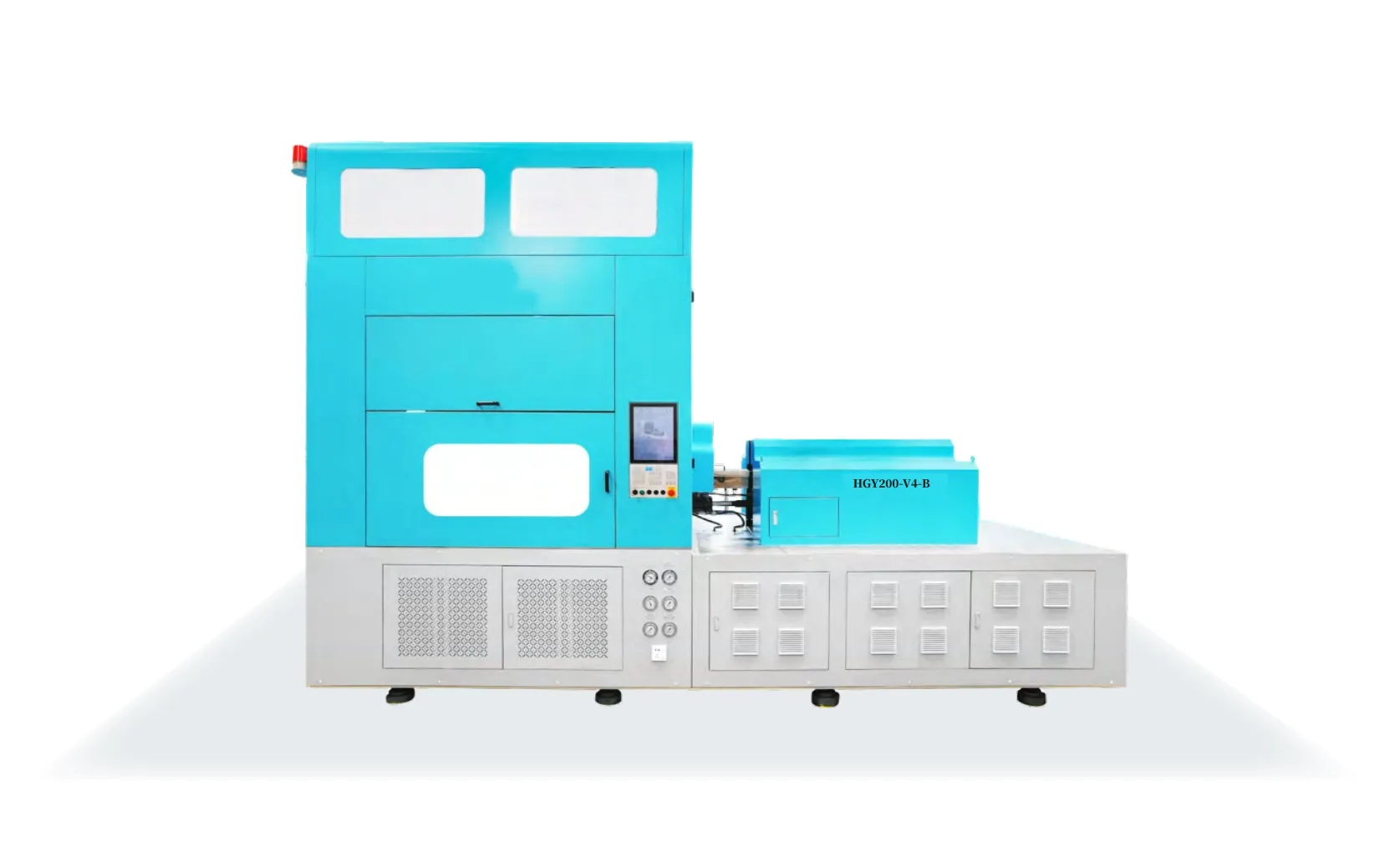
HGYS200-V4-B — Four-Station ISBM for Injectable Vial Production
For injectable vial and parenteral pharmaceutical container production requiring the highest dimensional precision, pharmaceutical GMP documentation capability, and multi-format flexibility to serve the diverse injectable application range, the HGYS200-V4-B four-station one-step ISBM machine provides the production platform appropriate for parenteral pharmaceutical ISBM operations. The machine’s injection neck system achieves ±0.05mm bore diameter and ±0.08mm retaining bead height tolerances — within the ISO 8471/8362 injectable vial neck specification tolerance for standard rubber stopper and crimp cap engagement. Process data logging with full cycle-by-cycle traceability generates the batch records that TGA parenteral GMP and IVD quality system compliance requires. The machine accommodates the full range of injectable vial neck finishes — from 8mm micro-vial formats for single-dose biologic applications through 20mm and 28mm standard injectable vial formats. Clean-room compatible design (eliminates hydraulic oil through servo-electric upgrade configuration; enclosed mechanical systems with low particulate generation) supports integration into ISO Class 7 injectable vial production environments. Processes pharmacopoeial-grade PET for injectable vials from 1ml single-dose formats through 50ml multi-dose injectable formats.